Down the Rabbit Hole: Unpacking the Paradoxes of Wonderland
As I delve into the fantastical world of Lewis Carroll's Alice's Adventures in Wonderland, I'm reminded that this tale is less a simple children's story and more a complex web of contradictions and paradoxes. The story begins with Alice's curiosity getting the better of her as she peeks down a rabbit hole and finds herself hurtling through a swirling vortex of colors and sounds. This moment of transition serves as a metaphor for the disorienting experience of confronting one's own inner demons, where the rational and irrational coexist in a state of symbiotic tension.
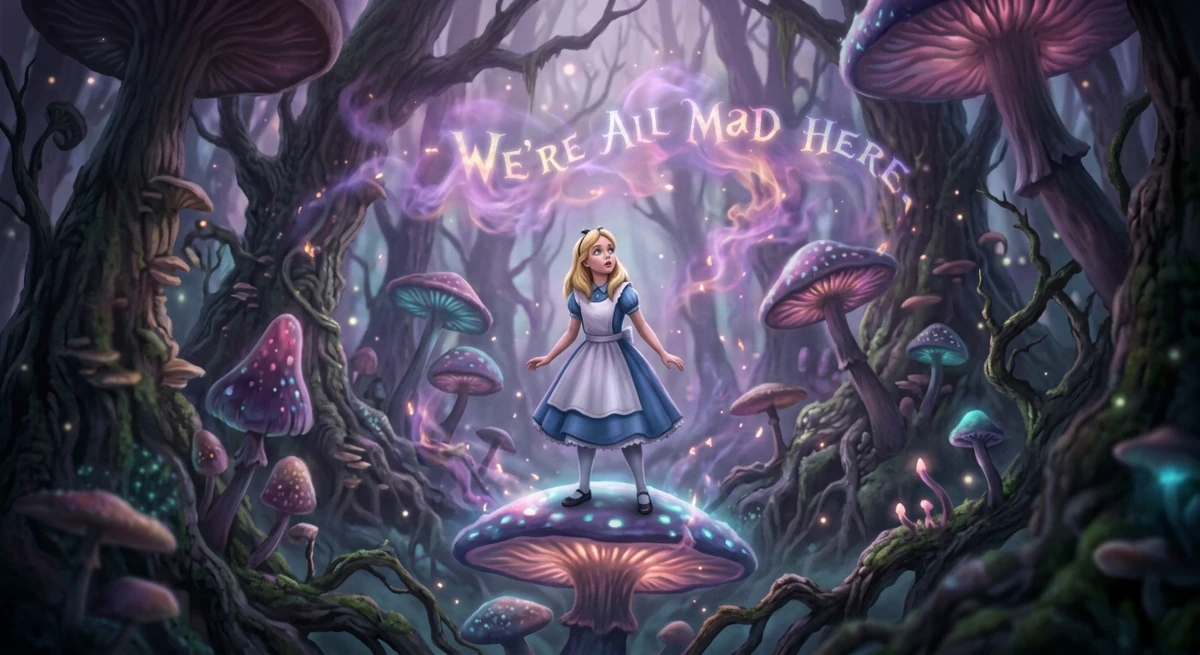
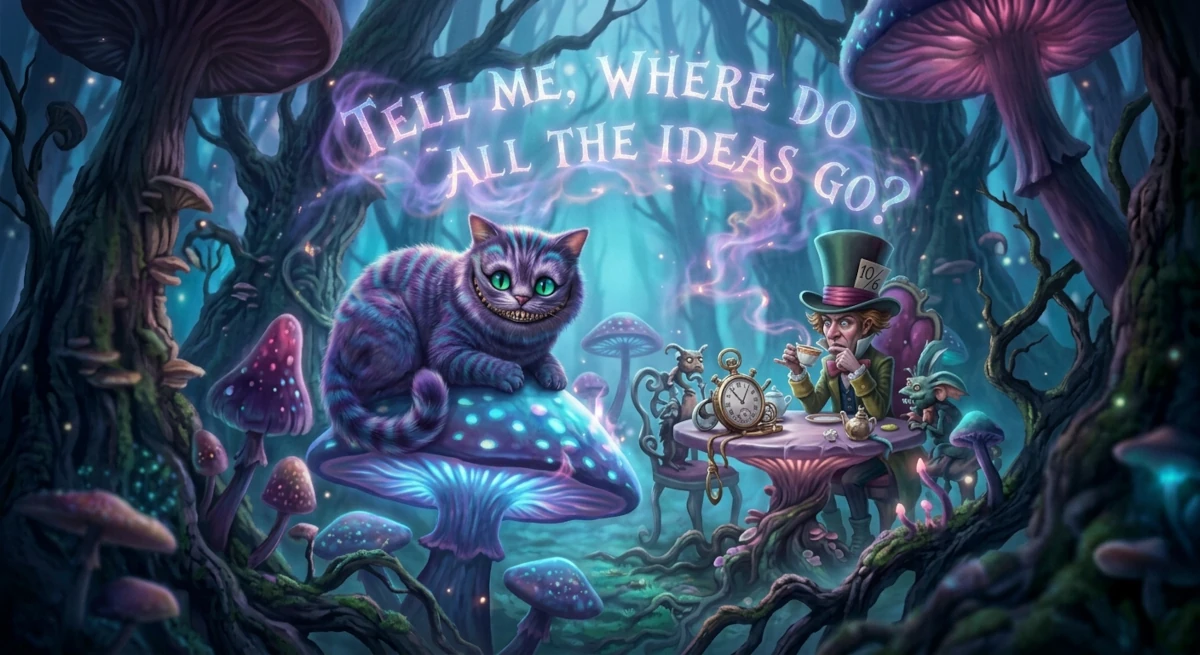
As Alice navigates Wonderland, she encounters various personas and archetypes that mirror her inner psyche. The Cheshire Cat, with its mischievous grin and ability to vanish and reappear at will, represents the enigmatic presence of the Other – an external force that disrupts our attempts to impose meaning on the world, reflecting back her deepest fears and desires while reminding us with "We're all mad here" that the line between sanity and madness is often blurred. Similarly, the Mad Hatter's ceaseless tea parties and illogical games demonstrate that our attempts to impose order are doomed to fail against the paradox of the impossible, where perfection remains forever out of reach like the White Rabbit's elusive goal. The Queen of Hearts' infamous outbursts further represent the explosive fury of the ego when confronted with feelings of inadequacy or powerlessness—a classic example of the death drive where an obsession with beheading exposes how our actions are guided by unconscious motivations and the dark side of our psyche.
Wonderland itself is a realm where the rational and irrational coexist in a state of symbiotic tension, serving as a backdrop for deep subconscious exploration. The Mushroom Forest, with its towering fungi and labyrinthine paths, symbolizes the collective unconscious—a place where we confront our shadow selves and integrate our opposites in order to emerge whole. Meanwhile, the "Drink Me" potion represents the intoxicating effects of psychoactive substances, offering a way to escape reality and tap into subconscious creativity, while cautioning that drinking from this cup to find solace often leaves us more lost and disoriented.
Ultimately, Wonderland remains an unsettling enigma and a gateway to the hidden recesses of our own minds. It serves as a reminder that the most powerful tools we possess lie within ourselves, and that our perceptions of reality are constantly subject to change based on individual perspectives and biases. Even as the story refuses to be solved, its secrets lie hidden within the labyrinthine paths of our minds, waiting to be uncovered by those brave enough to confront their own inner demons. The psychological landscapes of Wonderland extend far beyond its inhabitants, infiltrating the very rules, geometries, and inverted logic that govern the realm. Alice’s constant fluctuations in physical scale—shrinking after a single sip, expanding uncontrollably after a bite of cake—serve as a vivid manifestation of an unstable ego. In moments of disorientation or deep vulnerability, the self fluctuates wildly between feeling completely powerless and utterly oversized for its surroundings.
This distortion extends to the concept of time itself, as demonstrated by the Mad Hatter’s watch, which measures the day of the month rather than the hour. Here, Carroll rejects objective chronology in favor of psychological time, illustrating how the subconscious ignores linear progression to trap the mind in endless loops of unresolved thought patterns. Even language, Alice's primary shield against chaos, fails her completely. Her attempts to recite structured school lessons collapse into nonsensical rhymes, revealing how quickly conscious logic dissolves when confronted with raw, irrational emotion. By the time Alice reaches the nonsensical courtroom trial, where sentences are passed before verdicts and evidence is entirely irrelevant, the narrative parodies our internal moral judgment. We frequently condemn ourselves based on unconscious guilt long before rationally examining the facts of our actions. It is only when Alice finally stands her ground and declares, "You're nothing but a pack of cards!" that the illusion shatters. This moment marks the ultimate act of psychological integration: recognizing that the terrifying projections of the subconscious only hold authority so long as we accept their reality. By confronting her shadow self and dismantling Wonderland's arbitrary rules, she breaks the spell and returns to consciousness, fundamentally transformed. To dig deeper into this psychological geography is to recognize that Wonderland is not merely a passive theater of the mind, but an active, recursive engine of cognitive dissolution. Beneath the surface layers of archetype and symbol lies the terrifying fluidity of the threshold itself—the liminal space where the boundary between observer and environment completely collapses. Alice does not simply explore Wonderland; Wonderland actively deconstructs Alice, forcing her to confront the disturbing truth that the boundary separating internal thought from external reality is extraordinarily fragile.
This dissolution is most acutely felt in the dream-logic of transformation, where cause and effect are severed, and identity becomes entirely contextual. The physical environment acts as a living reflection of neurosis: the pool of tears she cries as a giant becomes the very ocean that nearly drowns her once she shrinks. Here, Carroll touches upon the recursive nature of psychological suffering, wherein our coping mechanisms and emotional reactions generate the very environments that continue to trap us. We build our own drowning pools out of forgotten distress, then struggle to swim through the residual waters of past emotional states. Furthermore, the pervasive absurdity of the dialogical interactions—the constant pedantry, shifting definitions, and linguistic traps set by the intrinsic inhabitants—exposes the fragile illusion of intersubjective reality. Communication in Wonderland does not bridge minds; it isolates them. Every character operates on a self-contained, solipsistic set of axioms, forcing Alice to realize that language often functions less as a tool for connection and more as an arbitrary structure designed to maintain localized insanity. To engage with Wonderland on its own terms is to accept that logic is not an inherent truth of the universe, but merely a comforting convention we project over the abyss.
Ultimately, the true depth of the narrative lies in its refusal to offer a neat resolution. Even when Alice awakens on the riverbank, brushing away a handful of dry autumn leaves, the psychological rupture remains permanent. Wonderland cannot be un-seen. Once the mind has crossed the threshold and recognized its own capacity for generating chaos, the waking world is forever tinged with the knowledge that sanity is just a thin, carefully maintained facade—a momentary pause in an endless, subconscious drift.