Steemit Curation by the Numbers: What the Data Reveals About Getting Rewarded in 2026
Introduction,
Most advice about succeeding on Steemit is qualitative — "write good content," "be original," "engage with your community." That advice isn't wrong, but it's incomplete. Steemit's curation system runs on a set of hard numerical rules: timing windows, voting-power caps, and rising stake thresholds that quietly reshape who gets rewarded and when. This post pulls those numbers directly from Steemit's own monthly curator announcements across 2026 and lays out what they actually mean for anyone trying to get noticed.
. The 15-Minute Rule: Curation Reward Splits Are a Timing Game
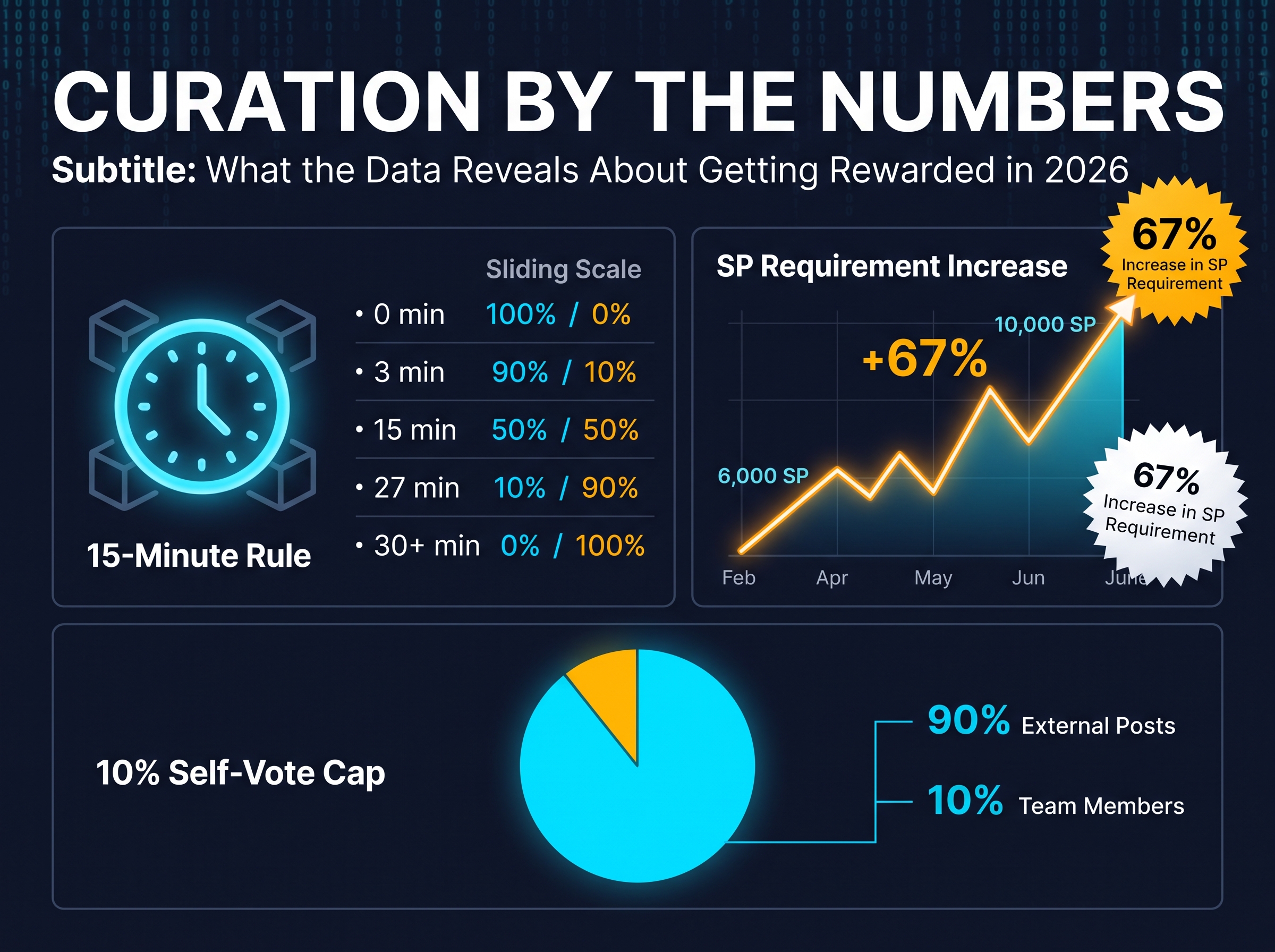
The most underused piece of data on the platform is the curation reward curve itself. It isn't a flat percentage — it's a sliding scale tied to how quickly a vote lands after a post goes up:
| Time after posting | Author's share of curation reward | Curator's share |
|---|---|---|
| Instant (0 min) | 100% | 0% |
| 3 minutes | 90% | 10% |
| 15 minutes | 50% | 50% |
| 27 minutes | 10% | 90% |
| 30+ minutes | 0% | 100% |
This single table explains a behavior pattern that's easy to miss if you only look at final payouts: "curators are structurally incentivized to wait", and authors are structurally incentivized to get early votes from people who already believe in the post, not to chase visibility immediately after publishing. Understanding this curve is more useful than any generic "post consistently" advice, because it tells you why early votes from small accounts are often worth less to the voter than a vote placed 15–20 minutes in — and why an experienced curator's timing habits aren't random.
. The Rising Cost of Being a Curator: A Six-Month Trend
Steemit publishes a minimum Steem Power requirement for each month's Community Curator applicants, and tracking that number across 2026 shows a clear upward trend:
- "February 2026:" minimum 6,000 SP per team member
- "June 2026:" minimum 10,000 SP per team member
That's roughly a "67% increase in the minimum stake requirement in four months". Read analytically, this tells us two things. First, competition for curator slots is intensifying — Steemit is raising the bar because more qualified teams are applying than there are available seats. Second, and more importantly for regular authors: the accounts doing the curating are increasingly high-stake, established users, not newcomers. If you're trying to get your content in front of a curation team, you're increasingly pitching to accounts with real skin in the game and a longer history on the platform — which raises the value of demonstrable quality and lowers the value of purely quantity-based posting.
. The 10% Weekly Cap: Why Team-Member Self-Voting Is Structurally Limited
Every curator team announcement repeats the same constraint: no more than 10% of the curation account's total voting power can go to the team's own members each week, distributed through daily rotation rather than lump votes. This is a deliberate anti-self-dealing mechanism, and it has a measurable effect on the ecosystem: it forces curator accounts to spend at least 90% of their weekly voting power on posts outside their own team. In practice, this means the majority of a curation account's influence is genuinely available to unaffiliated authors — the system isn't just curators rewarding each other. For an analytical reader, this is the single most reassuring data point in the whole structure, because it directly counters the common suspicion that curation on Steemit is a closed loop.
. The "Top 7" Report Structure as a Proxy for Selection Criteria
Each curator team is required to publish a weekly report in the Steem POD community listing their "top 7 posts", each with a short note explaining why it was chosen. This is effectively Steemit's only public dataset on curator decision-making, and it's underused by most authors. Two analytical takeaways:
- "Reports are graded." Steemit has stated that poor post selections can affect the reward given to the report itself — meaning curators are financially accountable for the quality of their picks, not just going through the motions. This raises the bar for what actually makes the "top 7" versus what merely gets a small vote.
- "The reports are a searchable feedback loop." Because these are public posts with stated reasoning, an author who wants to reverse-engineer what curators value can simply read a few months of "top 7" reports and look for repeated language — originality, formatting quality, and non-plagiarized/non-AI content are the recurring themes across announcements.
. What Pattern Emerges When You Put These Together
Looking at the four data points side by side — the 15-minute reward curve, the rising SP threshold, the 10% self-vote cap, and the accountable top-7 report structure — a consistent picture emerges: Steemit's curation system in 2026 is not built to reward speed or volume. It's built to reward "patience and verifiable quality", enforced through economic incentives rather than manual moderation.
- The reward curve discourages rushing.
- The rising stake requirement filters curators toward more experienced, invested accounts.
- The self-vote cap forces curation attention outward, toward the broader author base.
- The reporting requirement creates a paper trail that keeps curator choices honest.
For a writer, the practical implication is straightforward: consistent, well-formatted, original posts published on a predictable schedule will outperform sporadic high-volume posting, because nearly every structural incentive in the system is quietly built to reward exactly that pattern.
Closing Thought
Numbers rarely get discussed in Steemit strategy posts, but they tell a more honest story than testimonials do. The data suggests the platform's curation economy has been engineered — intentionally or not — to filter out short-term gaming and reward the kind of steady, quality-first contribution that most "how to succeed on Steemit" posts talk about only in the abstract.
Have you tracked your own post payouts against the vote-timing curve? I'd be curious whether other authors here have noticed the same 15-minute pattern in practice — drop your experience in the comments.