Why the Cheapest Tattoo Quote Is Not Always the Cheapest Tattoo
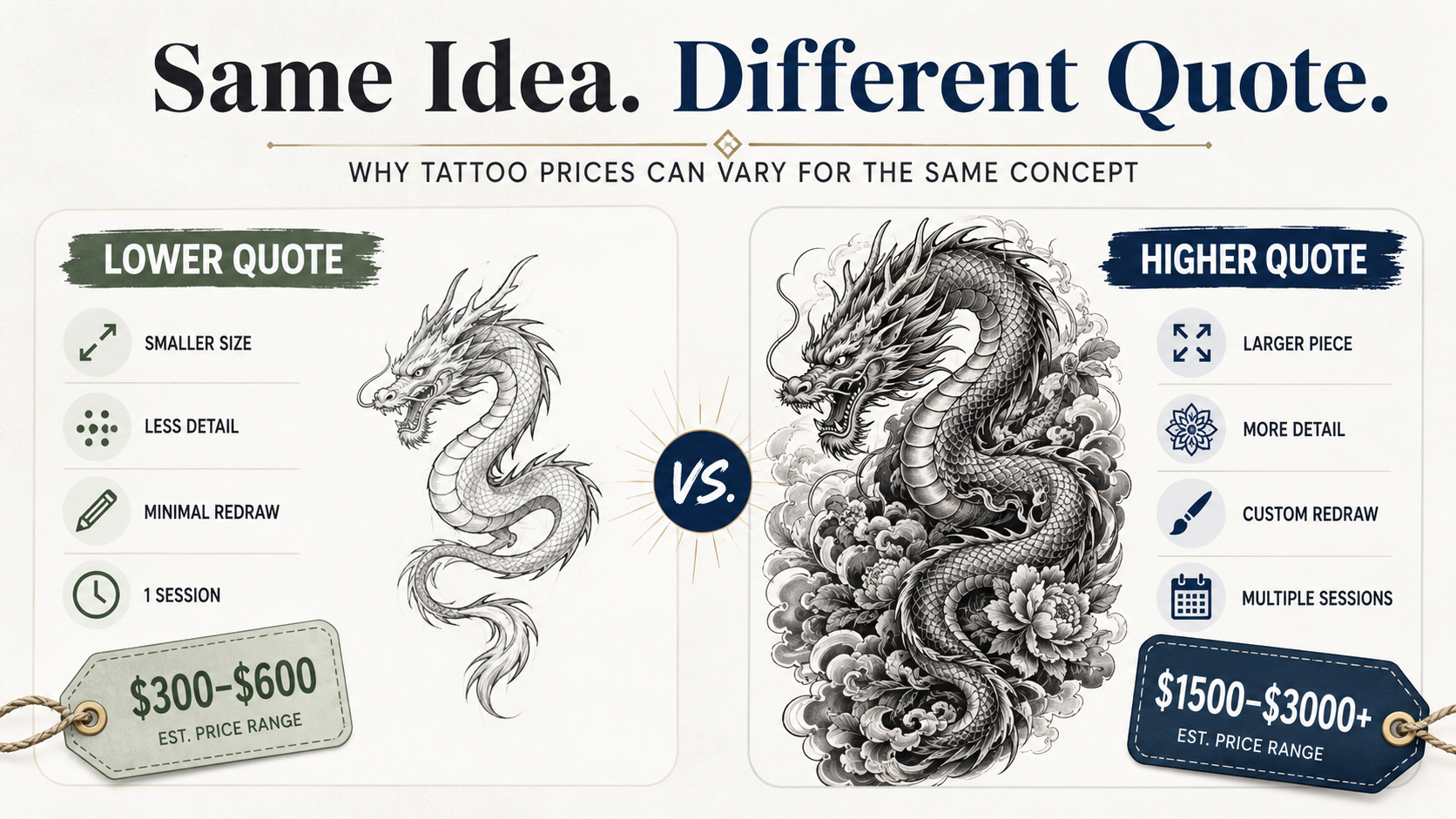
A lower tattoo quote can look like the obvious choice.
Sometimes it is.
But sometimes two artists are not actually quoting the same tattoo.
That difference matters more than the number at the bottom of the message.
A cheaper quote may mean a smaller scope
Imagine showing two artists the same reference image.
One artist plans to keep the design close to the reference, simplify some details, and tattoo it at a modest size.
Another artist plans to redraw the composition, adapt it to the body, add more detail, and make the piece larger.
Both are working from the same idea.
But they are not offering the same amount of work.
So the cheaper quote is not automatically the better deal.
It may simply describe a different version of the tattoo.
Size and detail change the job quickly
Tattoo cost is not only about how large the design looks.
A small, highly detailed tattoo can take more time than a larger, simpler one.
Fine lines, dense shading, color transitions, ornamental lettering, and layered compositions all add work.
Before comparing quotes, it helps to make sure both artists are working from roughly the same assumptions about:
- size
- placement
- style
- detail
- color
- number of sessions
Without that, the prices are difficult to compare fairly.
Placement can require extra redesign
A tattoo has to work on the body, not just on a screen.
A design that fits a forearm may need to be changed for the shoulder, ribs, chest, or calf.
An artist may need to:
- change the direction
- adjust proportions
- create more negative space
- simplify details
- rebuild the composition around the body
Some artists include more of that adaptation in the quote.
Others may be working from a simpler version of the idea.
Experience can affect both price and speed
An experienced artist may charge a higher hourly rate.
But that does not always mean the tattoo will cost dramatically more.
Someone who specializes in a particular style may work more efficiently because they already know how to solve the common design and placement problems.
Another artist may charge less per hour but need more time.
So hourly rate alone does not tell you the final cost.
Shop minimums also matter
Very small tattoos can surprise first-time clients because many studios have a minimum charge.
That minimum helps cover things that still need to happen even for a tiny tattoo:
- preparation
- setup
- sterile supplies
- cleanup
- consultation
- the artist's time
So a tiny symbol does not always cost proportionally less than a medium-sized tattoo.
The lowest number is not always the lowest total cost
If you choose a quote only because it is cheaper, but later decide the design needs major changes, another session, or additional work, the final cost may end up higher than expected.
That does not mean a low quote is bad.
It means the quote needs context.
The useful question is not only:
“Which artist charges less?”
It is:
“What exactly am I getting for this price?”
Compare scope before price
Before comparing tattoo quotes, try to make sure the main variables are similar.
For example:
- same approximate size
- same placement
- same style direction
- similar level of detail
- same color expectations
- similar session assumptions
Once those are aligned, the price comparison becomes much more meaningful.
I’ve been using those same variables in a Tattoo Cost Calculator to think through rough price ranges before an artist gives the real quote.
It is not a replacement for an artist’s estimate.
It is mainly a way to understand why changing one part of the tattoo plan can change the price.
The cheapest tattoo is the one you understand
A good quote should make sense in the context of the tattoo being planned.
If one price is much lower than another, that is not necessarily a red flag.
But it is worth asking whether the two artists are actually talking about the same size, detail, placement, and amount of custom work.
Sometimes the better question is not:
“Why is this artist more expensive?”
It is:
“What is different about the tattoo they are quoting?”
That usually leads to a much more useful comparison.