DLSS 5 vs DLSS 4.5: The Difference in Neural Rendering and Its Real Cost to Framerate
DLSS 5 and Neural Rendering: A Step Beyond Simple Upscaling
If you’ve been following Nvidia’s graphics technologies for a few years, you probably know that DLSS started as a simple trick: “Render at a lower quality and upscale with AI.” But version 5 is nothing like its predecessors.
Nvidia announced DLSS 5 at GTC in March 2026 and unveiled its technical details at SIGGRAPH 2026. Edward Liu, Nvidia’s director of applied deep learning research, described the technology as generative neural rendering, a combination of a condensed transformer diffusion model distilled from larger neural networks superimposed on the rendered game frame to produce a photorealistic image.
Here’s the thing: Before DLSS 5, AI played two roles in game graphics. One is Reconstruction, which reconstructs the full reference image from a limited render — the same thing that Super Resolution and Reconstruction do — and the other is Function Approximation, which replaces heavy computation with small neural networks. DLSS 5 adds a third category: real-time neural rendering.
How DLSS 5 differs from DLSS 4.5, the second-generation Transformer
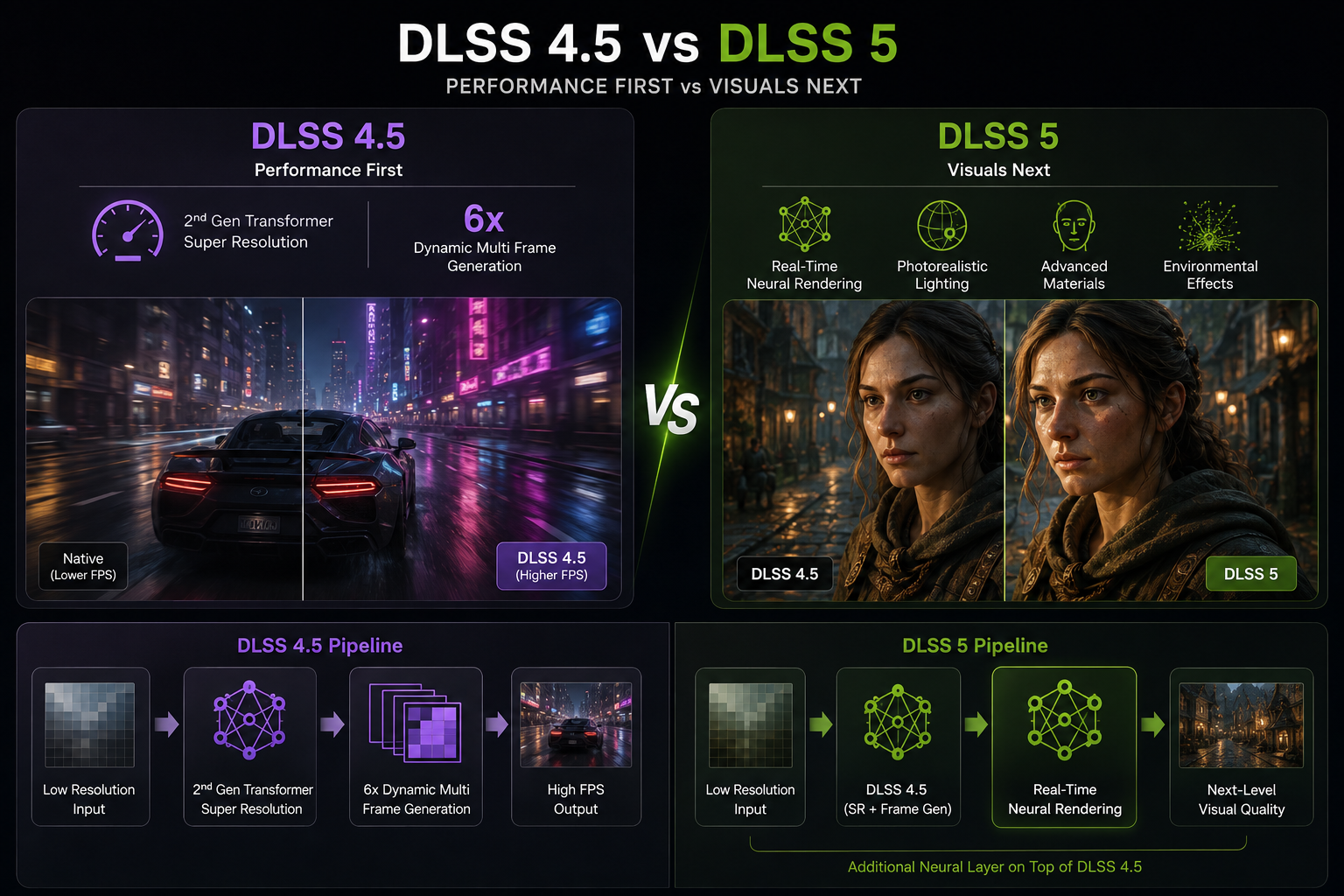
DLSS 4.5, which was introduced at CES 2026, was focused entirely on performance. This second-generation version introduced the Transformer model for super resolution and 6x Dynamic Multi Frame Generation. That is, the main goal was still more and smoother frames, not changes in the actual appearance of the scene.
DLSS 5 goes in a completely different direction. Unlike DLSS 4 and 4.5, which revolved around performance (upscaling and frame generation), DLSS 5 is concerned with visual quality. Its main feature is real-time neural rendering, which enhances lighting and materials with artificial intelligence and produces photoreal lighting, translucent skin, cloth details, and environmental effects. In essence, DLSS 5 rides on DLSS 4.5; that is, upscaling and frame generation are still the foundation of the work, and neural rendering is an additional layer on top of them.
Here's the thing. Where previous versions of DLSS gave you free frames, DLSS 5 does the exact opposite. A few early benchmarks (leaked and modded versions, not the final version) show this drop:
With a Core i7-14700F and RTX 5080, frame rates dropped from around 90 to 40 frames. That's more than half the frame rate.
On the RTX 5090 in Crimson Desert, enabling Natural and Cinematic modes increased frame rates from 58 to 37 frames at 4K — about 36 percent.
In Forza Horizon 6 on the RTX 5070, it dropped from 151 to 45 frames, and in Elder Scrolls IV: Oblivion, it nearly doubled.
On the RTX 5060, Control dropped from 86 to 34 frames, and the RTX 5070 Ti dropped from about 71 to 35 frames at 4K. GTA V dropped from 90 to 29 frames, and Final Fantasy VII Rebirth saw frame rates drop by almost half.
Martin Seed Magazine
In testing Skyrim, frame rates dropped from 80 to 120 to around 60 frames during the character creation scene, and dropped to 45 to 50 frames in the open world.
What most sources point out is that these numbers are for early, optimized versions, not the final version that will be released in the fall. Such a significant drop suggests that the current algorithm is in the early stages of optimization.
Is it really worth it?
The visual impact in some games is truly impressive — skin, hair, and cloth details, and character facial lighting can achieve near-prerendered quality, but the experience isn't necessarily pleasant for everyone and highlights the importance of fine-tuning DLSS 5 by game developers.
Summary: DLSS 5 is not a version that gives away free frames like DLSS 4.5; instead, it takes frames to give realism. Whether this trade-off is worth it depends on your hardware and what you expect from the game.