Beyond Static Props: The Rise of "Programmable Physical Assets" in Seasonal Entertainment
Editor's Note: This article is a curated adaptation originally published on the Sanhe Creature official website. Read the original full operational guide there.
Beyond Static Props: The Rise of "Programmable Physical Assets" in Seasonal Entertainment
In the Web3 and tech world, we talk a lot about digital assets, smart contracts, and software-defined everything. But what about the physical world? How are traditional, large-scale industries like event planning adopting an "asset-first" mindset?
At Sanhe Creature, we engineer large-scale animatronics. Recently, we’ve noticed a fundamental shift in how major seasonal events (Halloween festivals, Christmas markets) approach their entertainment budgets. They are moving away from single-use props and embracing what we call "Programmable Physical Assets."
Here is a look at how modular mechanical engineering is changing the economics of physical entertainment.
1. The Shift: From "Sunk Cost" to "Reusable Asset"
Traditionally, holiday decorations are treated as a sunk cost—a single-season expense that gets discarded or stored away.
Professional animatronics flip this financial logic. Because they are built on robust, modular mechanical platforms, they are assets, not expenses. The underlying hardware (motors, structural frames, control systems) is designed for a multi-year lifecycle, fundamentally changing the cost-per-use calculation for event organizers.
2. The "Reskin Strategy": Software-Defined Hardware
This is where the tech analogy gets real. A well-engineered animatronic is essentially hardware that can be reprogrammed and "reskinned" via software and physical modifications.
- October (Halloween): The same mechanical base is programmed with aggressive, sudden movements, paired with dark lighting and horror audio.
- December (Christmas): The movement algorithms are smoothed out, the lighting is shifted to warm tones, and the audio is updated to festive sounds.
This "Reskin Strategy" proves that the physical machine is just a platform; the experience is defined by the software and creative treatment. It’s the physical world’s version of deploying different apps on the same hardware.
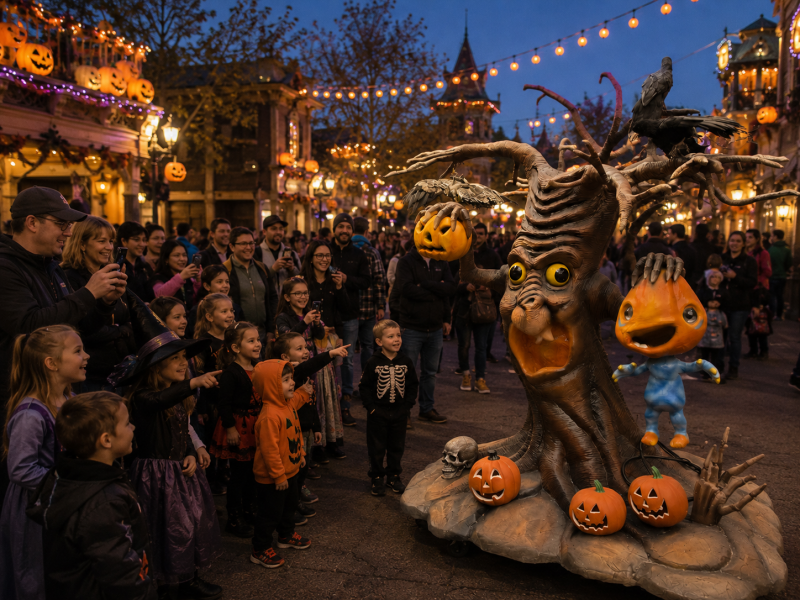
3. Capturing "Visual Gravity" in the Attention Economy
In an era where digital attention is fragmented, large-scale physical events face a massive challenge: how to capture and hold the attention of thousands of visitors in a sprawling outdoor venue.
Static decorations fail at this. They are passive. High-quality animatronics, however, create "Visual Gravity." By combining massive scale, kinetic movement, and synchronized spatial audio, they act as physical anchor points that interrupt the walking pace and force visitors to stop, gather, and organically generate social media content.
The Operational Reality
Building these reusable assets isn't just about buying a cool robot. It requires rigorous engineering considerations:
- Environmental Hardening: IP ratings for outdoor weather, UV-stable materials, and temperature-resistant joints.
- Modular Design: Components must be easily swappable for maintenance and "reskinning."
- Crowd Safety & Anchoring: Heavy kinetic machines require precise structural engineering to ensure public safety.
Read the Full Operational Framework
The concept of "Programmable Physical Assets" is exciting, but executing it requires a detailed operational blueprint.
On the Sanhe Creature official website, we have published a comprehensive guide specifically for event organizers and venue operators.
Inside the full guide, you will find:
- A detailed comparison: Animatronics vs. Live Performers vs. Light Shows.
- The 6 critical operational variables to consider before integrating kinetic assets.
- Our complete 6-Step Planning Framework for seasonal events.
👉 Click here to read the full "Animatronics for Seasonal Events" guide on our official website.
Lo de la "reskin strategy" es clave: la misma base mecánica con movimientos agresivos en octubre y suavizados en diciembre cambia por completo la economía del evento. Me quedó la duda de cuántos ciclos reales aguanta el hardware modular antes de necesitar mantenimiento mayor.
Es una pregunta técnica excelente y muy acertada.
La diferencia entre los movimientos agresivos (alta aceleración y torque) y los suaves afecta directamente la fatiga mecánica de los componentes. Por eso, no se puede dar una cifra única de "ciclos", sino que depende del componente:
Estructura principal y servomotores: Están dimensionados con un factor de seguridad alto. En condiciones normales, su vida útil de diseño supera las 15.000 - 20.000 horas de operación.
Componentes de transmisión y articulación: Aquí está la clave. Bajo el estrés de un uso intensivo estacional (por ejemplo, 8 horas diarias durante 30-45 días con movimientos agresivos), elementos como correas de transmisión, rodamientos de juntas o sellos suelen requerir una revisión o reemplazo preventivo cada 1.500 a 3.000 horas de operación real (aproximadamente 1 o 2 temporadas de alta intensidad).
Precisamente aquí es donde el diseño modular justifica su valor económico: cuando un componente de desgaste alcanza su límite, no se descarta el activo completo. El módulo afectado se puede desmontar y reemplazar en cuestión de horas, sin necesidad de recalibrar o desarmar toda la estructura.
El objetivo no es que el hardware sea "indestructible" (lo cual elevaría el costo inicial a niveles prohibitivos), sino que su mantenimiento sea predecible, rápido y localizado.
¡Gracias por plantear un punto tan relevante sobre la realidad operativa de estos activos!