Crypto Token Development Process: How Projects Turn Token Ideas Into Working Assets
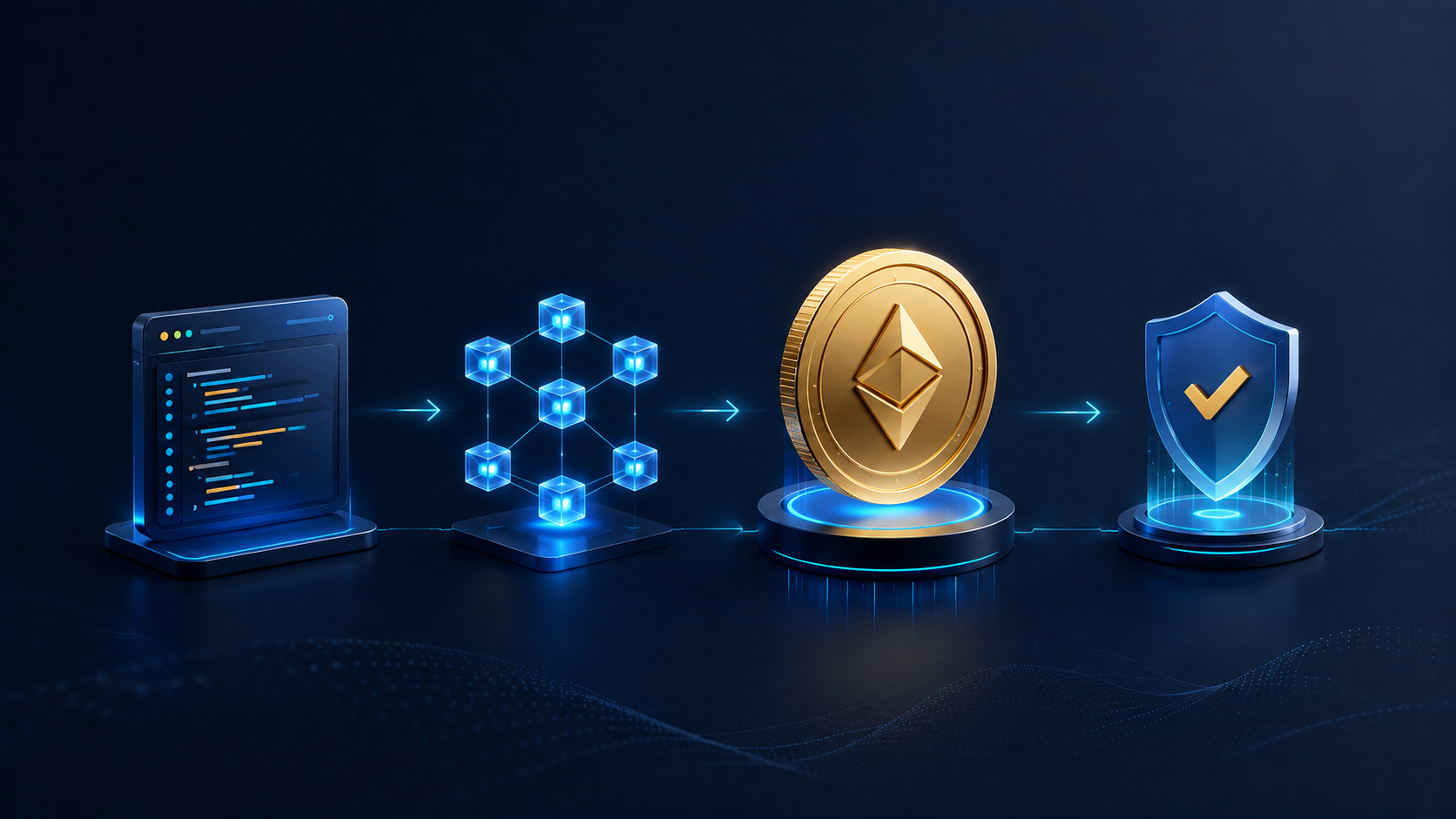
A crypto token can begin as a simple idea: a digital asset that gives users access to a product, rewards participation, enables governance, or represents ownership. Turning that idea into a functioning blockchain asset is far more involved. The development process connects product strategy, tokenomics, blockchain architecture, smart-contract engineering, security, compliance, testing, and launch planning.
The distinction matters because a deployed token is not automatically a useful token. A project can have technically valid code and still struggle with weak utility, poor distribution, concentrated ownership, insufficient liquidity, or unsustainable incentives. The development process must address these factors before the token reaches users.
This is especially relevant as the crypto market becomes more selective. CoinGecko reported that total crypto market capitalization ended Q2 2026 at $2.1 trillion, after falling 12.6% during the quarter. Centralized-exchange spot trading volume also declined 27.9% to $1.95 trillion. In this environment, projects have less room for poorly planned token launches. Strong architecture and clear economic design matter from the beginning.
1. Start With the Token's Role in the Product
The first stage of token development is not coding. It is defining why the token needs to exist.
A token should perform a meaningful function within a project's ecosystem. Depending on the business model, it can provide access to services, facilitate payments, reward users, support governance, represent an asset, enable staking, or coordinate activity across a decentralized network.
Consider a blockchain gaming project. Its token could be used to purchase digital items, participate in marketplace transactions, reward players, or vote on selected ecosystem decisions. An RWA platform representing tokenized assets would have very different requirements because the token may need to reflect ownership rights, transfer restrictions, investor eligibility, or claims connected to an underlying asset.
This stage is best approached as a product-design exercise. Teams need to establish who will use the token, what users receive from holding it, where it circulates, and what creates recurring demand.
A useful token concept should answer three questions clearly:
- What problem does the token solve?
- Why does the product need a token instead of a conventional database or payment mechanism?
- How does token usage grow as the underlying platform grows?
If those answers are unclear, technical development is premature.
2. Translate the Idea Into Tokenomics
Once utility is established, the project needs an economic model.
Tokenomics defines how tokens are created, allocated, released, used, and potentially removed from circulation. It influences incentives across the entire ecosystem, from founders and investors to users, validators, liquidity providers, and community members.
Supply design is particularly important. A project issuing one billion tokens needs to explain not only the maximum supply but also how many tokens enter circulation at launch and when the remaining allocation becomes available.
A typical tokenomics framework can include:
- Community and ecosystem allocation
- Team and advisor allocation
- Investor allocation
- Treasury reserves
- Liquidity allocation
- Partnerships and ecosystem growth
- Staking or user incentives
The exact percentages should reflect the project's operating model rather than imitate another project's allocation.
Vesting schedules are also part of development planning. Team and investor tokens can be subject to cliffs and gradual unlocks, helping align long-term incentives and reducing the risk of large immediate supply entering the market.
The distinction between maximum supply, circulating supply, and fully diluted valuation also needs to be communicated clearly. A token with a small circulating supply can display an attractive market capitalization while having a much larger future supply waiting to enter the market.
That makes tokenomics more than a marketing document. It becomes a set of economic rules that the technical architecture must eventually implement.
3. Select the Blockchain and Token Standard
The next decision is where the token will operate.
Ethereum remains a major option for fungible tokens because ERC-20 provides a standardized interface for balances, transfers, approvals, total supply, and related functions. Standardization also helps tokens interact with wallets, exchanges, and decentralized applications across the ecosystem.
Other networks offer different architectural advantages. Solana's Token Extensions, for example, allow projects to add capabilities such as transfer fees, confidential transfers, non-transferability, and other token-specific functionality. Several extensions need to be selected during token or account initialization, meaning the feature requirements must be considered before deployment.
The right choice therefore depends on the project's requirements rather than popularity alone.
A high-frequency application may prioritize transaction costs and throughput. A project targeting extensive Ethereum ecosystem compatibility may prioritize EVM infrastructure and established tooling. A regulated tokenization platform may place greater importance on transfer controls and permissioning.
The blockchain decision also affects wallet compatibility, exchange integration, developer tooling, transaction economics, and future scalability. Changing networks after launch can be disruptive, so architecture should be evaluated before development begins.
4. Define the Smart-Contract Architecture
After the economic and technical specifications are established, developers translate them into smart-contract logic.
A basic fungible token contract can manage balances, transfers, approvals, and supply. More advanced projects can introduce minting, burning, pausing, access control, transfer restrictions, staking interactions, vesting, or governance mechanisms.
The important principle is to implement only the functionality the product actually requires.
Every additional feature introduces more code and potentially more risk. For example, a mint function controlled by an administrator creates a different economic model from a fixed-supply token. A pause mechanism introduces an emergency control that needs clear authorization rules. An upgradeable contract creates another governance and security consideration.
Access control therefore becomes a major part of architecture. The development team needs to define which wallets or contracts can perform privileged actions and how those permissions are managed.
For larger projects, administrative functions should be separated from ordinary user functions, with appropriate safeguards around sensitive operations.
5. Build, Test, and Audit the Contract
Smart-contract development should move through structured testing rather than going directly from coding to mainnet deployment.
Developers first test individual functions and then test interactions between contracts. Edge cases are particularly important because blockchain transactions are deterministic and deployed contracts can be difficult or impossible to modify safely without an upgrade mechanism.
Testing should examine scenarios such as unauthorized access, supply manipulation, unexpected transfers, incorrect vesting calculations, permission failures, and interactions with other contracts.
Testnet deployment provides another useful stage. It allows teams to observe contract behavior in an environment that resembles production without putting real funds at risk.
Security audits then provide an independent review of the code and architecture. An audit does not guarantee that a token is completely secure, but it can identify vulnerabilities, logic errors, access-control weaknesses, and design risks that internal testing may miss.
For high-value projects, security should continue after launch through monitoring, permission reviews, incident procedures, and transaction analysis.
6. Build Compliance Into the Development Process
Token development also needs to account for the regulatory environment in which the project operates.
The legal treatment of a token can depend on its economic characteristics, rights, distribution model, fundraising approach, and target jurisdictions. A utility token, governance token, stablecoin, and tokenized security can therefore involve very different compliance requirements.
This becomes particularly important for projects distributing tokens to users in multiple countries.
Global adoption data shows why geographic planning matters. Chainalysis ranked India first in its 2025 Global Crypto Adoption Index, while APAC recorded a 69% year-over-year increase in on-chain value received during the measured period. The same report highlights how crypto use cases differ across markets, ranging from investment and trading to payments, remittances, and savings.
A project targeting several jurisdictions should therefore determine where its token can be offered, who can participate, and whether restrictions need to be reflected technically.
For certain token models, compliance requirements can influence the contract itself through whitelisting, transfer restrictions, identity-linked permissions, or controlled issuance.
7. Prepare Distribution and Liquidity
A token becomes a functioning market asset only when it can reach users and move through the intended ecosystem.
Distribution planning covers the token generation event, community allocations, investor releases, team vesting, treasury management, and other supply movements. These schedules need to align with the tokenomics model established earlier.
Liquidity is another critical consideration. Listing a token on an exchange does not automatically create a healthy market. Insufficient liquidity can produce high slippage and sharp price movements, while poorly timed unlocks can create additional selling pressure.
The project should therefore plan liquidity alongside the token launch rather than treating it as a post-development activity.
For example, a project could coordinate its initial circulating supply, liquidity allocation, vesting schedules, and market-making strategy so that the token enters the market with a clearer supply structure.
8. Integrate the Token With the Ecosystem
A token's usefulness depends partly on how easily users can interact with it.
Development teams need to prepare integrations with wallets, block explorers, decentralized applications, exchanges, staking systems, governance platforms, payment interfaces, and other relevant infrastructure.
Token standards help with this process. Ethereum's standards are specifically designed to make contracts more composable and compatible with existing applications.
Before launch, teams should verify contract metadata, token decimals, ownership settings, administrative permissions, explorer verification, transaction behavior, and integration compatibility.
These details can appear minor during development but become highly visible when users begin interacting with the asset.
9. Deploy and Monitor the Token
Mainnet deployment is the transition from development to production.
The deployment process should follow a predefined checklist covering contract addresses, ownership, permissions, verification, liquidity, distribution wallets, vesting contracts, and public documentation.
Once deployed, the project should monitor the token continuously.
Important indicators include holder concentration, large transfers, treasury movements, liquidity levels, contract permissions, token unlocks, and unusual transaction patterns.
Monitoring is especially important during the first days and weeks after launch because this is when technical issues, unexpected market behavior, and operational mistakes can have their greatest impact.
10. Treat Token Development as a Long-Term Process
The final stage is not really an endpoint. Token development continues as the ecosystem evolves.
New integrations can change demand. Governance can modify ecosystem parameters. Token unlocks alter circulating supply. New regulations can affect distribution. Product expansion can create new utility.
The broader market demonstrates why adaptability matters. CoinGecko's Q2 2026 report recorded a decline in both total market capitalization and trading activity, showing how quickly market conditions can change. Projects that rely entirely on short-term market enthusiasm face greater pressure when liquidity and attention decline.
A durable token therefore needs a product ecosystem behind it. The token should become more useful as the platform gains users, applications, transactions, or economic activity.
Conclusion
Crypto token development is the process of transforming an economic and product concept into a functioning blockchain asset. The smart contract is a critical component, but it represents only one part of the overall system.
The strongest development process begins with utility and tokenomics, moves into blockchain selection and contract architecture, and then progresses through testing, auditing, compliance, distribution, liquidity, integration, deployment, and monitoring.
The most important principle is to build the token around a real ecosystem need. When utility, economics, technology, security, and launch strategy reinforce one another, the token becomes more than a blockchain contract. It becomes a functional component of a Web3 product designed to operate beyond its initial launch.