From Blockchain Idea to Token Economy: A Practical Guide for Founders
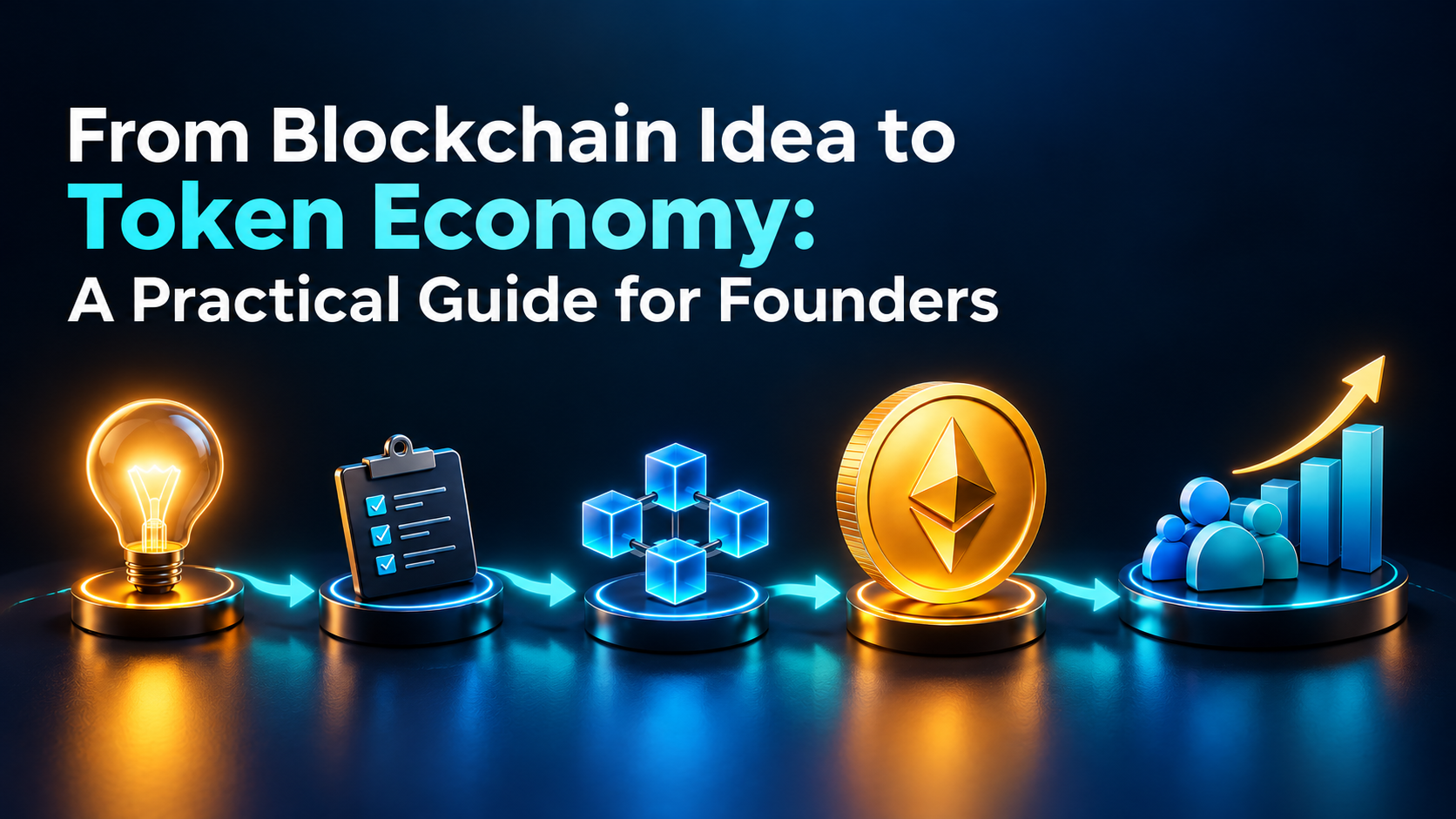
A blockchain business idea becomes commercially viable when its technology, users, and economic model work together. For founders, creating a crypto token is only one part of that process. The bigger challenge is designing a token economy that solves a real problem, encourages useful participation, and supports the business beyond its initial launch.
A well-designed token economy defines how tokens enter circulation, what users can do with them, how incentives work, and why participants continue engaging with the product. Poorly designed systems can attract short-term attention but struggle to retain users once promotional rewards decline.
Building a working token economy requires a clear business case, thoughtful tokenomics, suitable blockchain infrastructure, secure smart contracts, and measurable adoption goals. This guide explains how founders can move from an initial blockchain concept to a functional token-based business model.
1. Start With a Business Problem, Not a Token
The first step is identifying the business problem blockchain technology can solve. A token should support a useful activity rather than exist simply because a project wants to enter the Web3 market.
For example, a decentralized computing platform may need a mechanism for customers to pay providers for processing power. A digital marketplace could use tokens to coordinate payments and incentives between buyers and sellers. A gaming ecosystem might introduce tokens for selected in-game transactions or player participation.
Each example begins with an operational need. The token becomes part of the solution rather than the entire business proposition.
Founders should also compare blockchain-based approaches with conventional systems. A centralized database may be more practical when one organization controls the process and users do not need shared ownership or independently verifiable records. Blockchain becomes more compelling when multiple parties need to coordinate, verify transactions, or interact without relying entirely on one operator.
Before development begins, answer three questions:
- What problem will the business solve?
- Who will use the product, and why will they return?
- What specific role would a token play in delivering that value?
These answers establish the foundation for the economic model. Without them, token design can become an exercise in assigning features to an asset without proving that those features matter.
2. Decide What the Token Actually Does
Once the business purpose is clear, founders must define the token's role. Its functionality influences user behavior, technical architecture, distribution, and regulatory considerations.
Utility tokens may provide access to services, pay for network resources, or enable selected platform functions. Governance tokens can allow eligible holders to participate in protocol decisions. Payment-oriented tokens support transfers of value, while tokens representing interests in real-world assets require careful alignment with the underlying legal rights.
These categories can overlap, but their functions should remain understandable. A token designed for service payments has different economic requirements from one intended to coordinate governance or represent an investment interest.
Consider Ethereum's ETH. It serves as the native asset used to pay transaction fees and support network security through staking. Its role is connected to actual network operations rather than relying solely on promotional claims about future utility. Ethereum's documentation explains how gas fees compensate for computation and how proof-of-stake validators participate in network security.
A new project does not need to replicate Ethereum's design. Instead, founders should identify the smallest set of token functions needed to support their business model. Adding staking, governance, rewards, and multiple payment features simultaneously can create unnecessary complexity before the project has established demand.
A useful token design makes it clear why the token exists, who needs it, and what activities create demand for it.
3. Design Tokenomics Around Sustainable Participation
Tokenomics determines how tokens are created, distributed, used, and managed over time. These decisions affect user incentives, network participation, treasury planning, and the balance between token supply and demand.
Founders should begin by estimating how tokens will move through the ecosystem. Who receives the initial supply? How many tokens will be available to users? Will the project release additional tokens through staking rewards or ecosystem incentives? What happens when early investors and team allocations become transferable?
Consider a decentralized marketplace that rewards buyers and sellers with tokens. Generous rewards might attract early participants, but the model can become expensive if users collect rewards without generating meaningful business activity. If the project continuously issues tokens to maintain participation, selling pressure may increase while genuine demand remains unchanged.
A more sustainable design connects rewards to activities that create measurable value. A marketplace might reward verified transactions, while a computing network could compensate providers for delivering useful resources. The reward structure should reflect the economic contribution rather than simply the number of wallets or transactions.
Founders should also model different scenarios. What happens if user growth is slower than expected? Can the treasury fund planned incentives? Will token unlocks exceed the ecosystem's ability to absorb new supply?
The goal is not to guarantee token price growth. It is to create an economic system that can continue operating without depending entirely on speculation or constantly increasing rewards.
4. Choose the Right Blockchain and Technical Architecture
The blockchain determines how the token operates, which applications it can connect with, and what users experience when interacting with it. Network selection should follow business requirements rather than short-term popularity.
Ethereum offers established infrastructure and widely supported token standards. Solana provides a different execution environment, while other networks may appeal to projects with particular performance, privacy, or interoperability needs. Founders should compare transaction costs, throughput, ecosystem support, wallet compatibility, developer resources, and security assumptions before committing.
For fungible tokens on Ethereum-compatible networks, ERC-20 provides a standard interface for balances, transfers, and approvals. Standardization helps wallets, exchanges, and decentralized applications interact with compatible tokens without requiring each integration to start from scratch.
However, choosing a blockchain standard does not complete the technical design. The team must also define token supply controls, administrative permissions, transaction rules, and integrations with the product. A token that needs controlled issuance will require different safeguards from one with a fixed supply.
Cross-chain functionality introduces additional complexity. Bridges and cross-chain messaging systems can expand access, but they also introduce security dependencies. Founders should add these components only when the expected business value justifies the extra risk and maintenance.
The best architecture supports the intended user experience while leaving room for growth. A simple token economy with reliable integrations can be more useful than a complicated system with features the business does not yet need.
5. Build Security and Compliance Into the Design
A token economy relies on software that controls balances, permissions, transfers, and sometimes financial incentives. Vulnerabilities in this software can cause financial losses, disrupt services, or undermine confidence in the entire project.
Security planning should begin during architecture design rather than after the token contract is complete. Developers should review access controls, supply mechanisms, administrative functions, and interactions with external protocols. Independent audits can help identify weaknesses, but they cannot guarantee that a system is free from vulnerabilities.
Projects should also consider operational safeguards. Multisignature controls can reduce reliance on one administrator, while timelocks can give users time to review certain sensitive changes. Emergency pause mechanisms may help contain specific incidents, although their authority and limitations should be disclosed clearly.
Compliance requires equally early attention. Depending on the token's function and the jurisdictions involved, the project may need to consider securities laws, payment regulations, anti-money-laundering obligations, consumer protection, tax, and data privacy. A token representing rights to financial assets requires a different legal assessment from one that provides access to a digital service.
The Bank for International Settlements has highlighted both the potential benefits and risks of tokenization, emphasizing the importance of sound governance, risk management, and appropriate oversight.
Founders should work with qualified legal and security professionals before launching a token with financial or regulated functions. These considerations influence the token's design, distribution, transfer restrictions, and operating model.
6. Launch With a Product and Measure Real Adoption
A token launch should mark the beginning of ecosystem development, not the finish line. Founders need to test whether users understand the token, whether its utility works as intended, and whether the business model can support ongoing participation.
A staged rollout can help reveal weaknesses before the project expands. Start with a limited pilot, test essential transactions, collect user feedback, and evaluate how the token behaves under realistic conditions. The team can then adjust the product, incentives, and technical design before inviting a wider audience.
Adoption metrics should reflect the project's purpose. A payment-focused ecosystem might track repeat transactions and settlement reliability. A gaming project could measure active players and token usage within the game. A decentralized service might examine the number of users who return and the resources they consume.
Wallet counts and transaction volume remain useful, but they need context. A large number of wallets does not necessarily mean a large number of independent users, and high transaction volume may reflect automated activity rather than genuine customer demand.
Chainalysis's 2025 Global Crypto Adoption Index evaluates activity across several categories of cryptocurrency services, using on-chain data and other measures instead of relying on one indicator. The approach reinforces the importance of examining adoption from multiple perspectives.
For founders, the lesson is to measure whether the token helps the product deliver value. If users return because the service solves a problem, the project has a stronger foundation for sustainable growth.
Turn Your Blockchain Concept Into a Working Token Economy
Building a working token economy requires more than deploying a smart contract. Founders must connect a validated business need with meaningful token utility, sustainable tokenomics, appropriate blockchain infrastructure, strong security, and a clear adoption strategy.
Each decision influences the next. Token utility shapes economic incentives, tokenomics affects participation, technical architecture determines how the system operates, and product quality influences whether users continue engaging with it.
Blockchain App Factory provides crypto token development services for businesses exploring custom token creation, tokenomics planning, smart contract development, and blockchain deployment.
Before starting development, define the business outcome your token should support and establish how you will measure its success. A token economy built around real user needs has a stronger foundation than one built around launch hype alone.