Are Traditional Crypto Wallets Holding Back Token Adoption?
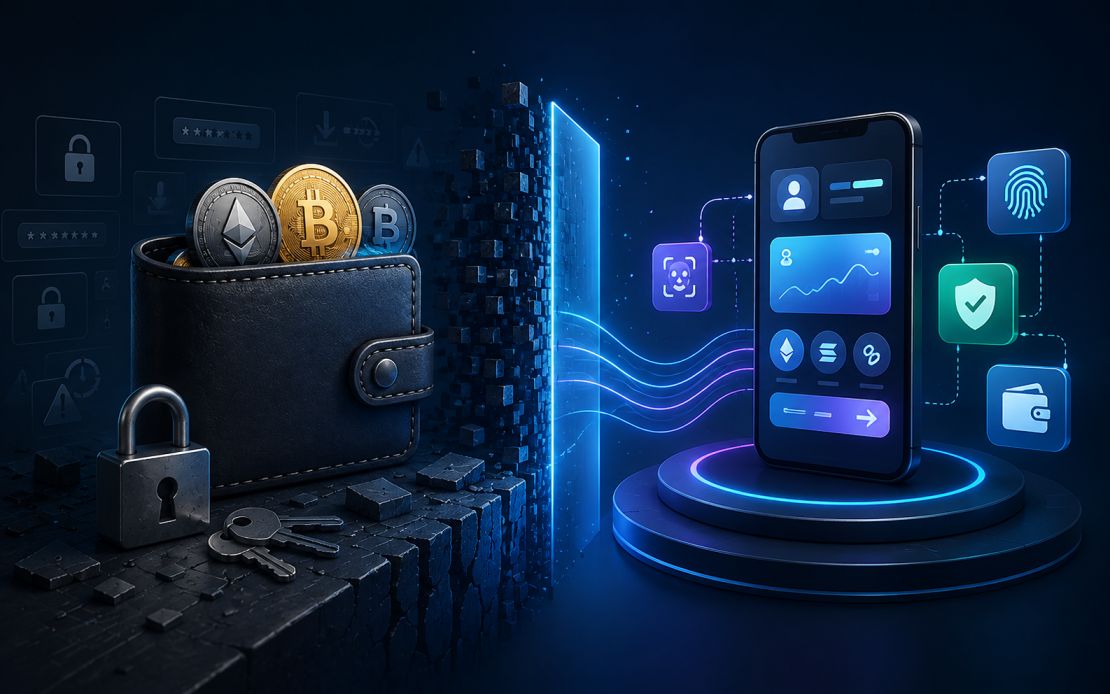
Crypto wallets are the gateway to token-based products. They hold assets, sign transactions, connect users with decentralized applications, and give people direct control over funds.
That control comes with friction.
A new user can face seed phrases, private keys, gas fees, network selection, transaction approvals, and wallet recovery rules before completing a simple token interaction. Each step makes sense inside blockchain architecture. Together, they can create a difficult onboarding experience.
The gap between ownership and active use shows why this matters. A16z estimated roughly 716 million crypto owners in 2025, but only 40 million to 70 million active crypto users. Mobile wallet usage reached record levels, yet active participation remained far below total ownership.
Wallet design is not the only reason for that gap. Still, wallet friction is a clear development problem. Ethereum itself states that using the network remains too complex for most people and identifies easier account management as a requirement for wider adoption.
For token developers, that raises an important question. Should users need to understand blockchain infrastructure before they can use a blockchain product?
Increasingly, the answer is no.
Why Traditional Crypto Wallets Create Friction
Most traditional Ethereum wallets rely on externally owned accounts, commonly called EOAs. A private key controls the account.
The model is technically simple. Whoever holds the private key controls the assets.
That creates a difficult security trade-off for everyday users. Losing the key can mean losing permanent access to tokens. Exposing the key can give an attacker control over the account. Seed phrases help users back up keys, but they place security responsibility directly on the individual.
Ethereum identifies seed phrase management as a usability problem even for experienced users. It also describes seed phrase phishing as a common attack method.
Transaction mechanics add another layer.
A user who receives an ERC-20 token can still need ETH to move it. A decentralized application can require separate approval and execution transactions. Users need to understand which network holds their assets. Switching networks or selecting the wrong address can create confusion.
None of these steps prevent experienced crypto users from participating. They create a higher learning requirement for someone who only wants to use an application.
Token Adoption Depends on More Than Token Utility
Developers often focus on the token itself.
They define supply, allocation, vesting, utility, smart contracts, and exchange compatibility. Those decisions matter, but adoption occurs through an entire user flow.
Consider a gaming platform that rewards a new player with tokens.
The player receives a useful asset, but spending it requires installing a separate wallet, storing 12 recovery words, acquiring another cryptocurrency for gas, changing networks, and approving several transactions.
The problem is no longer token utility. The access model creates the barrier.
This distinction matters for modern token development. A well-designed token can still struggle with adoption if interacting with it feels like infrastructure management.
The wallet should therefore become part of token product design rather than an external component added near launch.
Account Abstraction Is Changing the Wallet Model
Ethereum's account abstraction work addresses many limitations of traditional accounts.
Smart contract accounts can contain programmable rules for authentication, recovery, transaction execution, and gas payment.
ERC-4337 introduced one route without changing Ethereum's consensus protocol. Ethereum reports that the standard has already supported more than 26 million smart accounts and 170 million UserOperations.
The Pectra upgrade brought EIP-7702 to Ethereum in May 2025. It lets existing EOAs access smart-account behavior without forcing users to move to a new address.
These changes allow wallet developers to rethink common crypto interactions.
A smart account can support transaction batching. A user can approve a token and execute an action through one flow instead of signing each step separately.
Applications can sponsor gas. Users no longer need to obtain ETH before interacting with a token.
Accounts can support more flexible recovery systems. Developers can design backup keys, trusted recovery methods, or other authorization policies.
Ethereum has made native account abstraction one of its major user-experience priorities for 2026.
Gasless Token Experiences Remove a Major Barrier
Gas presents one of crypto's strangest onboarding problems.
Imagine receiving $20 worth of a token and discovering that you first need another asset before you can use it.
From a blockchain perspective, the rule is logical. Transactions consume network resources, and someone must pay for them.
From a product perspective, the experience is poor.
Account abstraction lets an application sponsor transaction fees or create another payment model. Ethereum published new developer guidance in April 2026 showing how smart accounts can hold tokens and interact with contracts through gasless flows.
This can change how businesses design token products.
A loyalty platform can cover transaction costs for customers. A game can let players use rewards without buying ETH first. A Web3 application can make initial token interactions look closer to familiar mobile software.
The network fee still exists. The product simply changes who manages it.
Recovery Can Become More Familiar
Traditional self-custody often presents users with two extreme outcomes.
Keep the seed phrase safe and retain full control. Lose it and risk permanent loss.
Programmable accounts create more options.
Ethereum describes smart accounts as a way to add backup keys, distribute security across devices or trusted parties, and replace compromised credentials. They can also impose rules for high-value transfers or restrict transactions to approved destinations.
This does not mean developers should recreate bank password resets without considering security.
Recovery design introduces its own risks. Weak recovery mechanisms can become attack routes. Trusted recovery participants can collude. Poorly designed smart-account code can expose funds.
The improvement comes from having programmable choices instead of one rigid key model.
Better Wallet UX Does Not Mean Hiding Every Blockchain Detail
There is a risk in taking abstraction too far.
Users still need to understand what they are approving. A simple interface should not hide important permissions, token transfers, recurring approvals, or irreversible actions.
EIP-7702 illustrates this issue. The mechanism gives EOAs access to powerful smart-account functions, but delegated code becomes part of the account's security boundary. Ethereum warns developers to rely on wallet-vetted implementations rather than casually asking users to delegate accounts to application-controlled code.
Better wallet design should reduce unnecessary technical work without reducing meaningful user control.
The goal is fewer confusing steps, not fewer security protections.
What This Means for Token Development
Token developers should now consider wallet experience during architecture planning.
Teams should ask how users will acquire tokens, store them, pay transaction costs, recover account access, and interact with application functions.
A modern token product can assess:
- Whether gas sponsorship improves onboarding
- Whether transactions can be batched
- How account recovery should work
- Which wallets support required features
- How permissions appear during signing
- Whether users need manual network switching
- How the product handles failed transactions
- Which security model protects high-value activity
These decisions become particularly valuable for consumer products. Gaming, payments, loyalty programs, social applications, and subscription products compete with Web2 experiences that rarely expose infrastructure to users.
Forcing every customer to become a wallet expert limits the addressable audience.
Are Traditional Wallets Really Holding Back Adoption?
Yes, in some cases, but they are only part of the problem.
Traditional wallets provide direct ownership and a proven account model. Experienced users value that simplicity and control. EOAs will remain useful for many applications.
The limitation appears when the same model becomes the default onboarding experience for every user.
Crypto ownership is already much larger than active on-chain participation. A16z's 2025 estimates put the difference at hundreds of millions of people.
Closing that gap requires useful products, better economics, clearer regulation, stronger security, and simpler accounts.
Wallet design is one part developers can directly improve.
The Next Token Experience May Feel Less Like Crypto
The next phase of token adoption does not require users to know less about ownership. It requires products to demand less infrastructure knowledge for routine actions.
Account abstraction, gas sponsorship, transaction batching, programmable recovery, and passkey-friendly designs are pushing wallets in that direction. Ethereum's 2026 protocol priorities show that these ideas have moved from niche wallet experiments into core infrastructure work.
For token projects, this changes development priorities. Teams should no longer treat the wallet as a separate application users must figure out themselves.
Wallet architecture, token functionality, security, and product UX now need to work together.
Blockchain App Factory works with businesses on token development across smart-contract architecture, wallet integrations, tokenomics implementation, security planning, testing, and Web3 product infrastructure. For projects targeting wider adoption, the key question is no longer only what the token does. It is how easily a real user can actually use it.