Token Development Companies and the Rise of Tokenized Assets
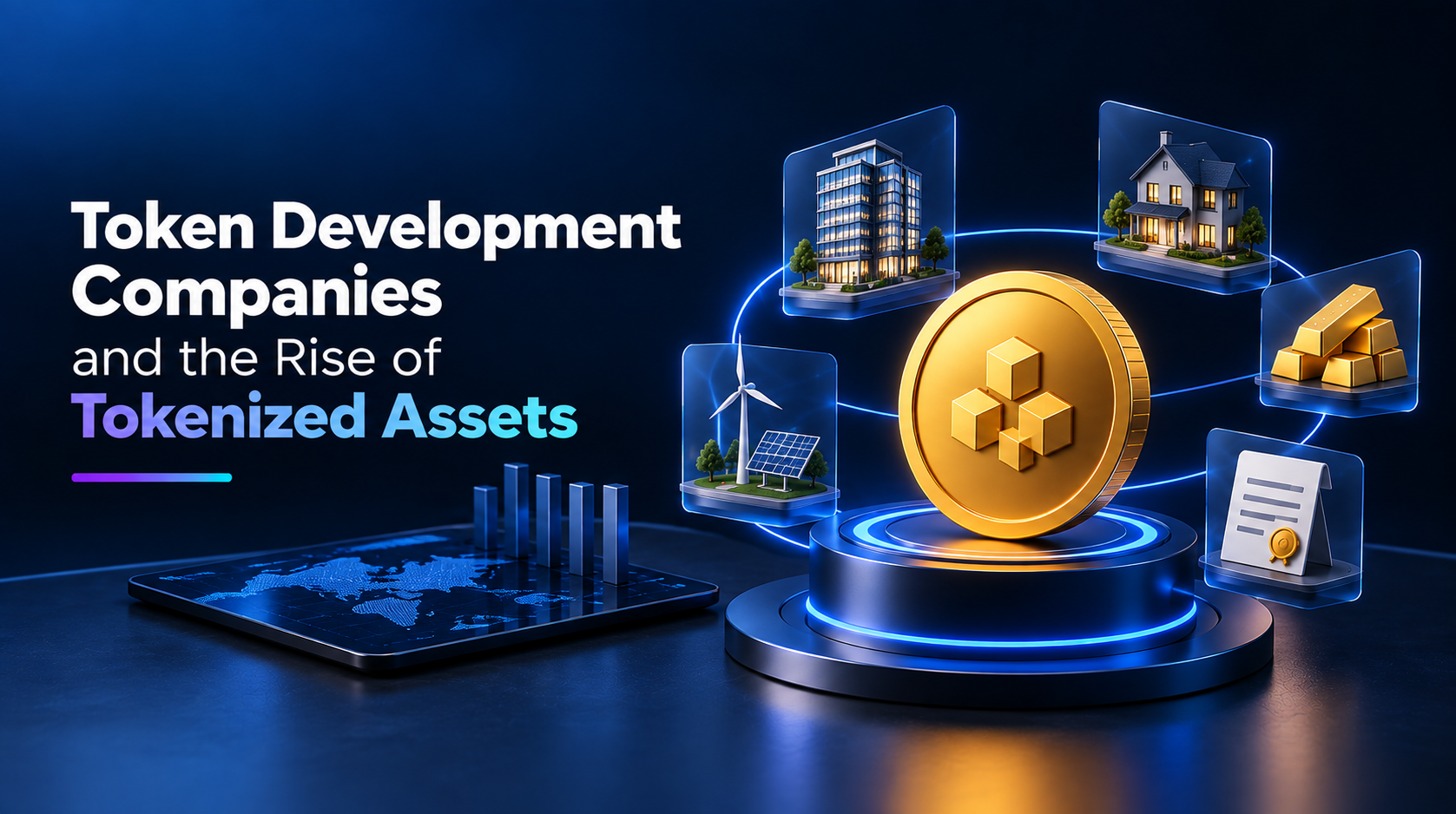
Tokenization is becoming one of the most important applications of blockchain technology in financial markets. Instead of creating digital assets with no connection to traditional value, tokenization allows claims on real-world assets to be represented and transferred through blockchain networks. Government bonds, investment funds, real estate, private credit, commodities, equities, and other assets are moving into programmable digital environments.
The market is already showing measurable growth. CoinGecko reported that tokenized real-world assets reached $19.32 billion in market capitalization by March 31, 2026, up 256.7% from $5.42 billion at the beginning of 2025. Tokenized Treasuries remained the largest category, while commodities, stocks, and ETFs expanded their share.
This growth is creating a new role for token development companies. Their work is no longer limited to deploying smart contracts. Businesses entering tokenization increasingly need infrastructure that connects blockchain assets with ownership rights, compliance systems, investor onboarding, custody, payments, reporting, and secondary markets.
What Is Driving the Rise of Tokenized Assets?
Tokenization converts an ownership claim, economic interest, or financial instrument into a digital token recorded on a blockchain. The important change is not simply putting an asset "on-chain." The real opportunity comes from combining the asset's ownership information with programmable rules governing its transfer and use.
The Bank for International Settlements describes tokenization as a process that can integrate information about assets with the rules governing their transfer. This creates possibilities such as programmable settlement, automated transactions, and delivery-versus-payment mechanisms.
Traditional financial transactions often involve separate systems for trading, clearing, settlement, custody, reconciliation, and record keeping. Tokenized infrastructure can bring some of these functions closer together. A tokenized bond, for example, can contain rules that restrict transfers to eligible investors while connecting settlement with a digital payment instrument.
This potential explains why tokenization is attracting both crypto-native companies and established financial institutions.
McKinsey estimates that tokenized market capitalization could reach approximately $2 trillion by 2030, excluding cryptocurrencies and stablecoins. Its analysis identifies mutual funds, bonds and exchange-traded notes, loans and securitization, and alternative funds as some of the asset classes with strong adoption potential.
Tokenized Assets Are Moving Beyond Early Experiments
Early blockchain tokenization projects often focused on proving that assets could be represented digitally. The market is now shifting toward practical financial applications.
Tokenized U.S. Treasuries are one of the clearest examples. They provide investors with exposure to traditional government securities through blockchain-based ownership structures. Tokenized commodities have also grown rapidly. CoinGecko found that tokenized commodities increased from approximately $1.4 billion to $5.5 billion between the beginning of 2025 and the end of Q1 2026, driven largely by gold-backed tokens.
Tokenized stocks and ETFs are also expanding. CoinGecko reported approximately $500 million in tokenized stocks and $300 million in tokenized ETFs by the end of Q1 2026. Tokenized stock trading reached $15.1 billion in Q1 alone.
Institutional activity provides another important signal. BlackRock's BUIDL fund has become a major example of tokenized financial products. The fund provides eligible investors with exposure to a portfolio backed by cash, U.S. Treasury bills, and repurchase agreements through tokenized fund shares. In 2026, BUIDL continued expanding across blockchain infrastructure, including its availability on Tempo.
These examples demonstrate a critical change in the market. Tokenization is increasingly being evaluated based on whether it improves an existing financial process rather than simply whether an asset can be represented by a token.
Why Token Development Companies Have Become Important
The rise of tokenized assets has expanded the responsibilities of token development companies.
Creating an ERC-20 contract is relatively straightforward. Building an infrastructure layer for a regulated tokenized fund, real-estate offering, or private-credit product is much more complex.
A token development company working on serious tokenization projects needs to understand the relationship between blockchain infrastructure and the underlying asset. The development process can involve asset modeling, token standards, investor eligibility, compliance rules, wallet management, smart contracts, custody integrations, oracle systems, payment rails, and reporting.
For example, a tokenized real-estate platform may need to connect a property-owning legal entity with fractional token ownership. Investors may need to complete KYC before receiving tokens. Transfer restrictions may prevent unauthorized wallets from purchasing or receiving them. Rental income can then be distributed according to token ownership.
The token is only one component of the system.
This is why businesses evaluating token development companies should look beyond claims about blockchain expertise. The more important question is whether the provider understands the complete asset lifecycle.
Compliance Is Becoming Part of Token Architecture
One of the most important developments in tokenized assets is the movement of compliance from an external process toward an integrated part of the technology stack.
Traditional crypto tokens often allow anyone with a compatible wallet to participate. Tokenized securities and other regulated assets can require restrictions based on investor identity, jurisdiction, accreditation status, holding periods, or other conditions.
Permissioned token standards such as ERC-3643 address this problem by incorporating identity and eligibility mechanisms into token transfer infrastructure.
For token development companies, this changes the development process. KYC and AML systems, identity verification, transfer restrictions, investor registries, and compliance monitoring need to interact with smart contracts and wallets.
The BIS has also emphasized that tokenization introduces governance, operational, legal, and financial-stability considerations. The technology can improve efficiency, but the benefits are not automatic and depend on appropriate risk management and regulatory structures.
This means a tokenization project cannot be treated purely as a software development exercise.
How Token Development Companies Are Evolving
The token development sector is moving from smart-contract delivery toward broader tokenization infrastructure.
A modern token development company can contribute to several layers of a project:
- Asset-backed token architecture
- Security and compliance-oriented smart contracts
- Investor onboarding and KYC integration
- Token issuance and distribution platforms
- Custody and wallet integrations
- Asset valuation and oracle connectivity
- Automated distributions and corporate actions
- Tokenized fund and real-estate platforms
- Secondary-market and exchange integrations
- Analytics and investor dashboards
The exact technology stack depends on the asset.
A tokenized bond requires different logic from a fractional real-estate platform. A commodity-backed token requires mechanisms for custody and proof of reserves. A tokenized fund requires subscription, redemption, valuation, transfer, and reporting processes.
The best development approach therefore begins with the legal and economic structure of the asset and then designs the blockchain architecture around it.
Tokenization Can Create New Financial Workflows
The most compelling value of tokenization may not be fractional ownership alone. Programmability can change how transactions are executed.
The BIS has highlighted delivery-versus-payment as a major example. In a tokenized environment, the transfer of an asset and its corresponding payment can be linked so that one action occurs only when the required condition on the other side is satisfied.
This can reduce reconciliation and manual processing.
Consider a tokenized private-credit transaction. Instead of separate systems recording the loan, investor ownership, payment instructions, and settlement, programmable infrastructure can connect these processes. Interest payments can be distributed according to token holdings. Certain contractual conditions can trigger automated actions.
The same concept applies to funds, bonds, commodities, and other assets.
The result is potentially more than a digital representation of an existing asset. It becomes a programmable financial instrument.
The Growing Importance of Secondary Markets
Issuing a token does not automatically create liquidity.
This is one of the most important distinctions businesses need to understand. A tokenized asset can still be difficult to trade if there is no compliant marketplace, sufficient investor demand, reliable pricing, or appropriate transfer infrastructure.
Token development companies are therefore increasingly expected to consider secondary-market requirements from the beginning.
This includes exchange integrations, investor eligibility checks, transfer restrictions, order management, settlement mechanisms, liquidity providers, and market-data infrastructure.
The growth of tokenized commodities illustrates the potential. CoinGecko reported $90.7 billion in spot trading volume for tokenized gold during Q1 2026, already exceeding the $84.6 billion recorded across the whole of 2025.
That activity suggests that tokenization becomes more valuable when digital assets have functioning markets rather than simply existing as blockchain records.
What Businesses Should Look for in a Token Development Company
Choosing a development partner requires a broader evaluation than checking blockchain expertise.
First, businesses should assess whether the provider has experience with the specific asset class being tokenized. Real estate, securities, funds, commodities, and private credit each have different technical and regulatory requirements.
Second, the provider should understand compliance architecture. This includes investor verification, wallet screening, permissioned transfers, jurisdiction restrictions, and appropriate audit trails.
Third, security should cover the complete platform rather than only the token contract. Smart-contract audits are important, but access controls, administrative wallets, APIs, investor databases, custody integrations, and upgrade mechanisms also need protection.
Finally, companies should evaluate the provider's ability to support the project after launch. Tokenized assets require ongoing maintenance, regulatory updates, contract upgrades where appropriate, investor servicing, monitoring, and integrations with financial infrastructure.
The right development partner is therefore closer to a tokenization infrastructure partner than a conventional smart-contract developer.
The Future of Token Development and Tokenized Assets
Tokenization is still developing, but its direction is becoming clearer.
The financial industry is moving toward blockchain infrastructure that connects assets, money, identity, and settlement. The BIS has described a future model in which tokenized central bank reserves, commercial bank money, and government securities operate within a more integrated programmable financial environment.
At the same time, tokenization still faces real challenges. Regulation differs across jurisdictions. Asset ownership needs legally enforceable structures. Liquidity cannot be created through technology alone. Oracle failures, smart-contract vulnerabilities, custody risks, fragmented blockchain networks, and operational complexity remain important concerns.
The sector's growth should therefore not be measured only by the number of tokens issued. More meaningful indicators include assets under management, transaction volume, investor participation, settlement efficiency, regulatory compliance, and the ability to connect tokenized assets with existing financial markets.
Conclusion
The rise of tokenized assets is changing the role of token development companies. What began as smart-contract development is becoming a broader discipline involving compliance, asset servicing, investor management, settlement, and secondary-market connectivity. As tokenization moves beyond experimentation, businesses need infrastructure that connects real-world assets with secure and programmable blockchain systems.
Blockchain App Factory helps businesses explore this transition through custom token development and RWA tokenization solutions tailored to different asset classes, blockchain networks, compliance requirements, and business models. As tokenized assets move deeper into mainstream finance, the right development partner can help businesses build secure, scalable, and sustainable tokenization ecosystems.