The UAE Freelance Visa: Is It Actually Worth It in 2026?
In the years gone by, moving to the UAE as a professional was almost like entering a win-lose situation. Newcomers generally had two choices: take a job, obtain an employment visa and work under the required sponsorship arrangement, or invest substantial money in setting up a local business, often through a Free Zone.
Nevertheless, the fast-growing world of remote working in the UAE, combined with the introduction of the 5-Year Green Visa and more flexible Free Zone regulations, has brought the UAE Freelance Visa into the spotlight.
Various marketing claims on social media present it as a shortcut to 100% legal residency, with no personal income tax and an easy, inexpensive way to move to the UAE.
But can a freelance visa really serve as a long-term basis for self-employed professionals, remote workers and digital nomads in 2026? Or is it simply an attractive but limited solution?
The truth is much more complicated than the advertisements suggest.
While a freelance route can work well for a limited number of independent professionals, it comes with limitations for those who want to expand their business, employ people or regularly bill larger corporations.
Below, you’ll find an honest review of the UAE Freelance Visa in 2026, looking at what the structure actually offers and where its limitations begin.
Deconstructing the Legal Framework: Permit vs. Visa vs. Company
Before looking at costs and jurisdictions, it is important to clarify the terminology that can often confuse incoming expatriates.
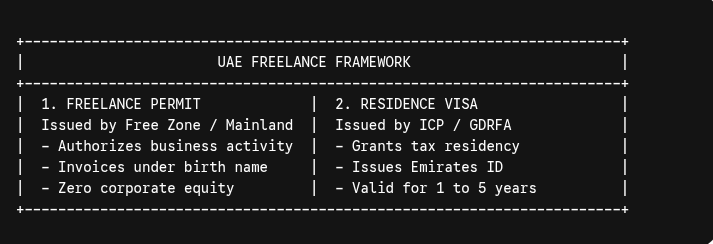
A “Freelance Visa” is not one particular document. In practice, the route involves two separate regulatory elements:
The Freelance Permit (Trade License): This is issued by a Free Zone authority or, depending on the structure and jurisdiction, a relevant department of economy such as ADDED in Abu Dhabi or DET in Dubai. It allows an individual to conduct permitted professional activities under the applicable freelance or sole-practitioner framework.
The Residence Visa (Immigration Status): This is issued through the relevant UAE immigration authority, such as the Federal Authority for Identity, Citizenship, Customs and Port Security (ICP) or the General Directorate of Residency and Foreigners Affairs (GDRFA), depending on the emirate and visa route. It gives the holder legal residence in the UAE and enables them to obtain an Emirates ID.
These two elements are connected, but they are not the same thing.
That distinction becomes important when deciding whether freelancing is enough for your long-term plans or whether establishing a full company would make more sense.
The Dubai Development Authority refers to its offering as a Freelance License (Sole Professional License). It recognizes the individual as a sole proprietor and allows them to work under their legal name instead of a commercial name.
The service costs AED 7,500, plus AED 10 for the Knowledge Dirham and Innovation Dirham collected by the authority. The DDA states that the service takes around two days.
Abu Dhabi takes another route. It calls its ADRA Freelancer Licence a sole proprietorship and allows the license holder to work from home without leasing or owning office space. Its base fee is AED 1,200 and includes six activities chosen by the licensee. Any additional activities cost AED 100.
According to ADRA, the licence may also allow the holder and their family to obtain residency, subject to the applicable requirements.
Thus, it is important for anyone looking into freelance licensing and the company formation process in UAE to first determine what they actually need:
- The right to conduct their permitted activities
- The right to live and work in the UAE
- The right to operate an independent business
Key Legal Differences: Sole Practitioner vs. Single-Member LLC
When you have a freelance permit, you do not establish a separate company. Instead, you obtain permission to provide services under the applicable freelance framework.
Name and Brand:
There is generally no option to register a separate commercial name such as Apex Marketing Solutions. Contracts and invoices are issued under the freelancer's registered legal name, subject to the applicable authority's rules.
Liability:
Unlike a Single Member LLC, which is a separate legal entity and can provide limited liability subject to applicable law, a freelancer generally remains personally responsible for their professional obligations and contracts.
Company Share and Capital:
A freelance permit does not create company shareholding. Therefore, it does not provide a structure for issuing shares, bringing investors into the business or transferring company ownership in the way an LLC can.
Permitted Free Zones, Authorities, and Office Requirements in 2026
Freelance permits in the UAE are jurisdiction-specific. You cannot perform an activity under a freelance permit unless that activity is permitted and included within the scope of your licence.
There is also no need to examine every free zone in the country. A few official structures already show how different the market can be.
Here is how the primary authorities structure their freelance offerings in 2026, including office requirements and sector limitations:
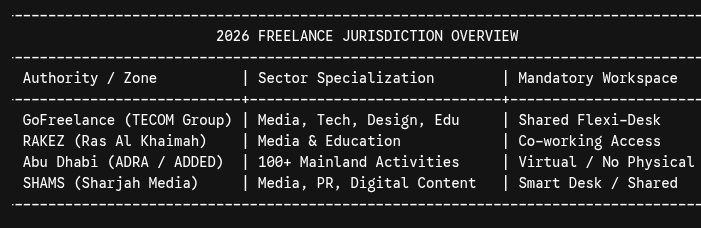
Dubai Development Authority (GoFreelance — TECOM)
- Target Sectors: Tech, including software development and data analysis; Media, including videography, copywriting and journalism; Design, including UI/UX, fashion and interior design; and Education, including e-learning consultancy and tutoring.
- Workspace Requirement: The programme provides access to shared flexi-desk facilities across TECOM business hubs, including Dubai Internet City, Dubai Media City and d3. A dedicated physical office is not required for the freelance setup.
Ras Al Khaimah Economic Zone (RAKEZ)
- Target Sectors: Media and education specialists.
- Workspace Requirement: The freelancer offering includes access to RAKEZ Compass Coworking Hubs and provides a business address for official communications without requiring a conventional physical lease such as Ejari or Tawtheeq.
Abu Dhabi Mainland (ADRA & ADDED)
- Target Sectors: More than 100 mainland service activities, ranging from management consulting to IT system architecture and specialised technical design.
- Workspace Requirement: The Abu Dhabi Freelancer Licence allows eligible applicants to operate without a physical office lease or commercial premises, subject to the applicable activity and licensing requirements.
ADRA’s low base fee is particularly notable because the authority also states that a physical office is not required.
DMCC’s current schedule lists AED 4,020 for FreelanceUAE Package 1 and specifies that this package includes only the FreelanceUAE licence valid for one year. This is a useful example of why a licence price should not automatically be treated as the total cost of living and working in the UAE.
RAKEZ publishes its Freelancer Permit from AED 6,100 and includes business-centre access as part of its freelancer offering.
SPC’s five-activity rule can be particularly useful for professionals whose services naturally fall within the same field. UAQ’s published structure, meanwhile, allows two related activities under its Freelancer Permit.
Who the UAE Freelance Visa Is Designed For
When evaluated objectively, the freelance permit is a targeted option that works best in specific situations.
It is particularly suited to three professional profiles:
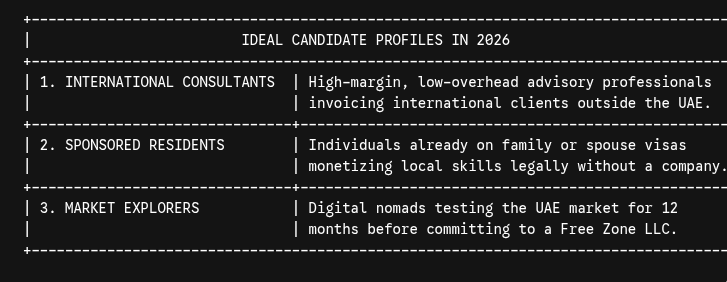
Profile 1: International Solo Consultants
If you provide strategy, software engineering, digital design or media consultancy to clients outside the UAE, a freelance permit can give you a legal route to residency while keeping the setup relatively simple. Your clients can contract with you directly, payments can be transferred electronically and you do not need to build a full company structure with employee visas and other corporate requirements.
Profile 2: Dependent/Spouse Visa Holders Monetizing Local Skills
If you are already living in the UAE under a spouse’s or family member’s visa sponsorship, some authorities offer a “Permit Only” option without requiring you to pay for separate residency visa processing. This can provide a cost-effective way to legally invoice clients, carry out permitted independent work and meet the applicable UAE labour requirements.
Profile 3: Digital Nomads Testing the Waters
Setting up a Free Zone company in UAE involves corporate banking setup, office arrangements and ongoing administrative requirements.
For solopreneurs, a one-year freelance permit can be a practical way to experience living in Dubai or Abu Dhabi, test the local market and build a client network before committing to a full corporate setup.
Do UAE Freelancers Need an Office?
For the one-person professional setup discussed in this article, the straightforward answer is often no.
ADRA’s Freelancer Licence explicitly states “No Office Required” and allows eligible freelancers to operate from home.
The UAE Ministry of Economy’s free-zone guidance also recognises freelancer licences and refers to office and virtual-office arrangements within the free-zone licensing framework.
RAKEZ’s Freelancer Permit is structured around access to business-centre facilities rather than requiring a traditional private office as the starting point.
DMCC provides another useful example. Its freelance licensing framework does not impose the commercial-premises lease requirement that applies to some other licence structures.
For a remote consultant, developer, writer or designer, this is one of the clearest economic advantages of the freelance model. There is little point in paying for a conventional commercial office when the entire business can be delivered from a laptop.
However, this should not be confused with permission to operate any type of business from home. A regulated physical activity must still meet its own premises and regulatory requirements. A freelance software developer and a professional running a physical clinic are clearly not comparable licensing cases.
What Does It Actually Cost to Freelance in the UAE in 2026?
The relatively attractive price of a freelance permit, compared with the cost of a full corporate setup, is one reason many independent professionals choose this route.
What people sometimes overlook is that a lower permit fee does not mean the permit provides the same scope as a company structure. The quoted permit fee generally covers the permit itself and may not include residence visa processing, immigration charges or other costs associated with living and working legally in the UAE.
This brings us to the more important question: what does a freelance setup actually cost?
Rather than looking only at the advertised permit price, it makes more sense to consider the total amount payable over a two-year period, including the relevant freelance permit, residence and immigration costs and other applicable expenses.
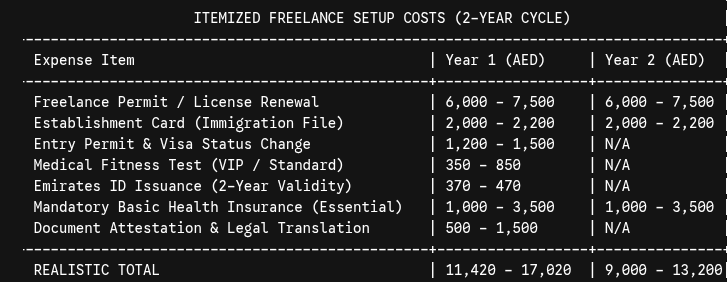
The real financial comparison is therefore:
Licence + residence costs + Emirates ID and medical requirements + health insurance + any workspace costs + renewal costs.
EXAMPLES:
ADRA: AED 1,200 for the basic Freelancer Licence, including six investor-selected activities. Additional activities are AED 100 each.
DMCC: AED 4,020 for FreelanceUAE Package 1, which the current schedule identifies as the one-year licence only.
RAKEZ: Freelancer Permit from AED 6,100.
DDA: AED 7,500 permit fee, plus AED 10 Knowledge Dirham and AED 10 Innovation Dirham.
UAQ FTZ: Its current website advertises a Freelance Permit + Visa at AED 1,818 per month.
Key Budgetary Considerations
Year 1 Capital Requirement: A practical budget may need to be higher than the advertised permit price alone. Depending on the authority, visa status and additional requirements, an operational first-year budget of around AED 12,000 to AED 17,000 may be worth considering.
Dependents Sponsorship: If you plan to sponsor family members such as a spouse or children, additional costs will apply for their residence visas, medical requirements and health insurance. Any applicable security deposit or bond also depends on the relevant authority and sponsorship arrangement.
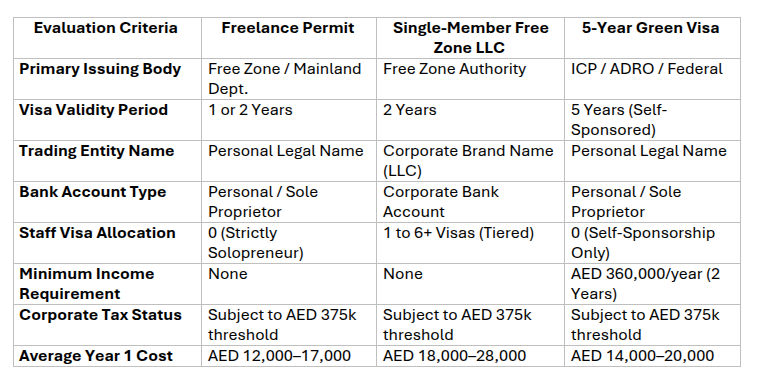
Strategic Matrix: Freelance Visa vs. Free Zone LLC vs. 5-Year Green Visa
To determine whether the freelance route makes sense for your business, it helps to compare it directly with the two main alternatives in 2026: a Single-Member Free Zone LLC and the 5-Year Green Visa for Freelancers.
Green Visa for a Period of 5 Years
If you are an established freelancer with a proven track record, the UAE Green Visa offers a 5-year self-sponsored residency option that does not require an employer or traditional sponsor.
Eligibility Conditions: For the freelancer category, applicants generally need to meet the applicable education, professional permit and income requirements. These can include a Bachelor’s degree or equivalent qualification, a freelance work permit from the Ministry of Human Resources and Emiratisation (MOHRE), and evidence of annual freelance income of at least AED 360,000 for the previous two years. Applicants who do not meet the income threshold may need to demonstrate sufficient financial solvency, subject to the applicable requirements.
Where the UAE Freelance Route Quietly Fails
Although the freelance visa can be a good fit for solo operators, it has its own limitations when used as the foundation for a growing business.
The following are four areas where freelancers can face significant challenges in the UAE.
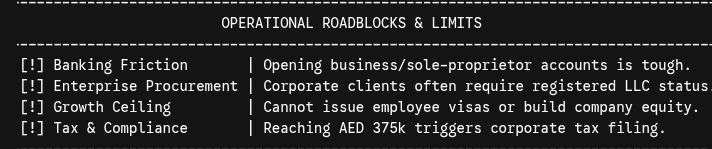
Roadblock 1: The Corporate Banking Bottleneck
One of the challenges freelancers can face in the UAE is opening a dedicated business bank account.
Unlike companies with a separate legal entity, freelancers generally operate under their own legal identity. This can mean additional compliance checks when applying for a business banking facility. International payments may also prompt questions about the nature of the business, source of funds or the purpose of specific transactions.
For freelancers handling larger international payments, having clear contracts, invoices, proof of business activity and source-of-funds documentation can therefore become particularly important.
Roadblock 2: Corporate Procurement and Invoicing Barriers
Larger UAE-based companies, government organisations and multinational companies often have detailed vendor onboarding procedures.
Procurement teams may ask vendors for documents such as business registration records, tax registration details where applicable, a business bank account and relevant insurance coverage.
When an independent contractor submits a quotation under their personal name rather than through a registered company, the client's procurement system or internal policies may not always accommodate that structure.
This does not mean a freelancer cannot work with larger organisations. It simply means that the client's vendor requirements should be checked before relying on a freelance structure for a major contract.
Roadblock 3: The Hard Ceiling on Growth and Equity
A freelance licence is designed around the individual professional rather than a separate company.
Limited Hiring Structure: A freelance permit does not provide the same employee sponsorship and visa framework available to a company. If you need to build a team, you may eventually need to move to a corporate structure.
Limited Scalability: As your workload increases and you need additional employees, contractors or a broader operating structure, the freelance model can become restrictive.
No Transferable Company Equity: A freelance permit does not create company shares or business equity that can be issued to investors or transferred in the same way as shares in an LLC.
Once you outgrow the freelance setup because of increasing clients, staffing requirements or expansion plans, it may be time to consider a corporate structure. You can also review different setup options, costs and visa quotas in our guide to Dubai Free Zone company formation.
Roadblock 4: UAE Corporate Tax and Compliance Regulations
A widespread misunderstanding is that freelancers automatically have no Corporate Tax or accounting obligations in the UAE.
Under Federal Decree-Law No. 47 of 2022 on the Taxation of Corporations and Businesses, natural persons conducting business activities in the UAE can fall within the scope of Corporate Tax when the applicable revenue threshold is exceeded.
For a natural person, the relevant threshold is AED 1 million in annual business turnover, not AED 375,000. The AED 375,000 figure is the Corporate Tax rate threshold, at which the 9% rate applies to taxable income above that amount.
Therefore, holding a freelance permit does not, by itself, mean that your business activity is outside the UAE Corporate Tax framework. Freelancers should assess their turnover, taxable income, registration requirements and any available reliefs based on their individual circumstances.
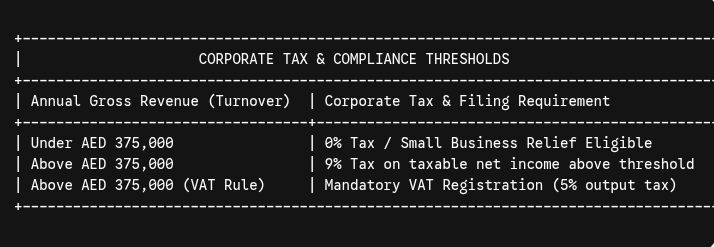
Things Freelancers Need to Do:
Corporate Tax: Freelancers operating as natural persons should assess their Corporate Tax obligations based on their business turnover. If the total turnover from business activities exceeds AED 1 million in a Gregorian calendar year, Corporate Tax registration may become applicable. The AED 375,000 figure is relevant to the Corporate Tax rate, not the registration threshold for a natural person.
Accounting Requirement: Freelancers should maintain proper records of their business income, expenses and supporting documents and retain them for the period required under UAE tax rules. Good financial records also make it easier to calculate taxable income and support any information submitted to the Federal Tax Authority (FTA).
VAT Requirement: VAT registration becomes mandatory when taxable supplies and imports exceed AED 375,000 over the relevant 12-month period or are expected to exceed that threshold within the next 30 days. Voluntary VAT registration is available from AED 187,500, subject to the applicable conditions.
The Final Verdict: Is the UAE Freelance Visa Worth It in 2026?
In that regard, the UAE Freelance Visa still ranks among the more practical ways for independent professionals to establish a presence in the Gulf region, provided their business model fits within the relevant legal and licensing framework.
For a solo consultant, designer, developer, writer or other independent professional, the appeal is fairly straightforward: you can operate without immediately taking on the cost and administration of a full company structure.
But the freelance route is not a universal substitute for company formation.
If your plans involve hiring employees, bringing in shareholders, building a separate business brand, signing larger corporate contracts or creating an asset that can eventually be transferred or sold, a company structure may make more sense from the beginning.
The best option, therefore, is not necessarily the cheapest licence. It is the structure that matches how you earn today and how you expect your business to operate tomorrow.
+-----------------------------------------------------------------------------------+
|                                  FINAL DECISION                                   |
+-----------------------------------------------------------------------------------+
|  [YES] IT IS WORTH IT IF:                                                        |
|  - You are a solo consultant, creator, or remote tech professional.              |
|  - Your business turnover is below the AED 1 million Corporate Tax threshold.   |
|  - You do not need to hire employees or sponsor staff visas.                     |
|  - Your clients are comfortable contracting with you under the permitted setup.  |
+-----------------------------------------------------------------------------------+
|  [NO] IT MAY NOT BE WORTH IT IF:                                                 |
|  - You plan to build a team, agency, or scalable corporate brand.                 |
|  - You require a company structure for complex banking transactions.             |
|  - You rely heavily on enterprise procurement contracts in the local market.     |
|  - You want to create corporate equity that can be valued, transferred, or sold. |
+-----------------------------------------------------------------------------------+
Recommended Next Steps
If you are considering operating as an independent freelancer or forming an LLC through a Free Zone immediately, look beyond the initial licence price and consider your plans for the next 24 months.
Assess your client agreements, expected turnover, banking requirements and plans for building a team. The right structure will depend on how you intend to earn, operate and grow.
Choosing the right setup from the beginning can help you avoid having to restructure the business later as your requirements change in the UAE.