CereBree: Unlocking the Next Generation of AI Through Connected Data, Blockchain, and Human-Centered Intelligence
Introduction
A person may use one platform for education, another for career development, another for mental wellness, and several different systems for healthcare. Businesses operate separate tools for customer service, sales, operations, analytics, and human resources. Healthcare providers often work with disconnected records, applications, and institutions. Each system may be intelligent within its own boundaries, but very few can understand the larger context surrounding a person, organization, or decision.
This is the problem CereBree is designed to address. CereBree is an onchain AI ecosystem for enterprise workflows, healthcare systems, and human intelligence. Rather than building a single generic AI assistant, CereBree is developing a connected ecosystem of purpose-built AI platforms across enterprise operations, clinical healthcare, and individual growth. At the center of this ecosystem is Cognie, CereBree's proprietary execution-focused large language model (LLM). Cognie provides a shared intelligence layer that connects products, data, workflows, and context across the ecosystem. The underlying infrastructure is powered by the Oracle Blockchain Platform, while the $CRX token provides an economic coordination layer for payments, access, staking, governance, rewards, and ecosystem value accrual.
Introducing CereBree an onchain AI ecosystem
CereBree is an onchain AI ecosystem built to transform enterprise workflows, healthcare systems, and human intelligence through connected, intelligent technology. Its products are unified by Cognie, CereBree’s proprietary LLM, and supported by the Oracle Blockchain Platform, creating an integrated foundation for AI-powered growth and well-being. CereBree brings learning, work, health, and personal well-being together within a single intelligent agent platform designed to evolve alongside you throughout every stage of life. Rather than treating these areas as separate pieces, CereBree recognizes how deeply they influence one another. Your career can shape your wellness. Your learning can influence your purpose. Your health provides the foundation for everything you do. That’s why CereBree is designed to understand the whole person—not isolated parts. Whether you’re developing new skills, advancing your career, improving mental fitness, managing your health, or preparing for the next chapter of your life, CereBree adapts to your goals, needs, and changing circumstances.
Its mission is straightforward: make growth and well-being more accessible to everyone by combining intelligent AI with a more human-centered approach. CereBree aims to deliver technology that is not only capable and intelligent, but also adaptive, supportive, and compassionate.
The CereBree Ecosystem at a Glance
CereBree is positioning itself as a lifecycle intelligence ecosystem designed to connect people, healthcare, and enterprise operations through a shared artificial intelligence layer. Rather than treating AI as a collection of isolated tools, CereBree aims to create one connected intelligence environment where information and context can move across different areas of life and organizational activity. ([CereBree][1])
At the center of this ecosystem is Cognie, CereBree’s proprietary AI intelligence layer. The platform is also integrated with $CRX and blockchain infrastructure, creating an economic and technological foundation for its ecosystem of applications. ([CereBree][2])
Three Core Ecosystem Pillars
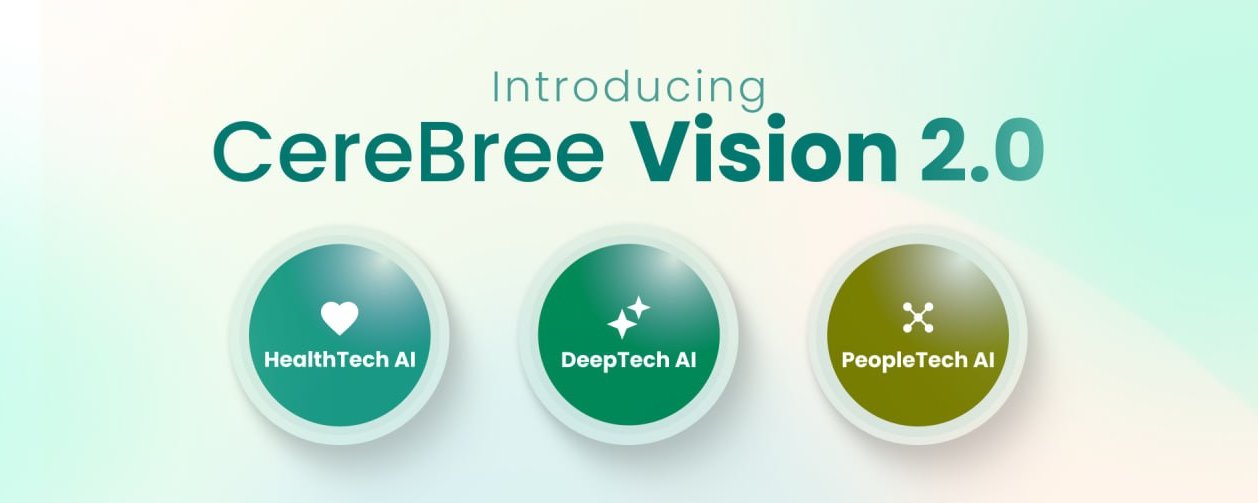
CereBree organizes its broader vision around three major areas:
1. HealthTech AI
Healthcare is where fragmentation creates significant challenges. Patients may interact with multiple physicians, hospitals, pharmacies, laboratories, and healthcare systems. Information can become distributed across institutions. HealthTech AI within the CereBree ecosystem aims to address this fragmentation through intelligent healthcare systems.
Key products include:
- CereAura — AI-powered support for autism and neurodevelopmental care.
- CereOnco — an intelligent care layer designed around cancer journeys.
- HealOpera — a hospital workflow and healthcare relationship intelligence layer connecting areas such as patients, clinicians, operations, revenue, and research.
The goal is to move healthcare away from fragmented information and disconnected workflows toward a more coordinated intelligence layer.
2. DeepTech / Enterprise AI
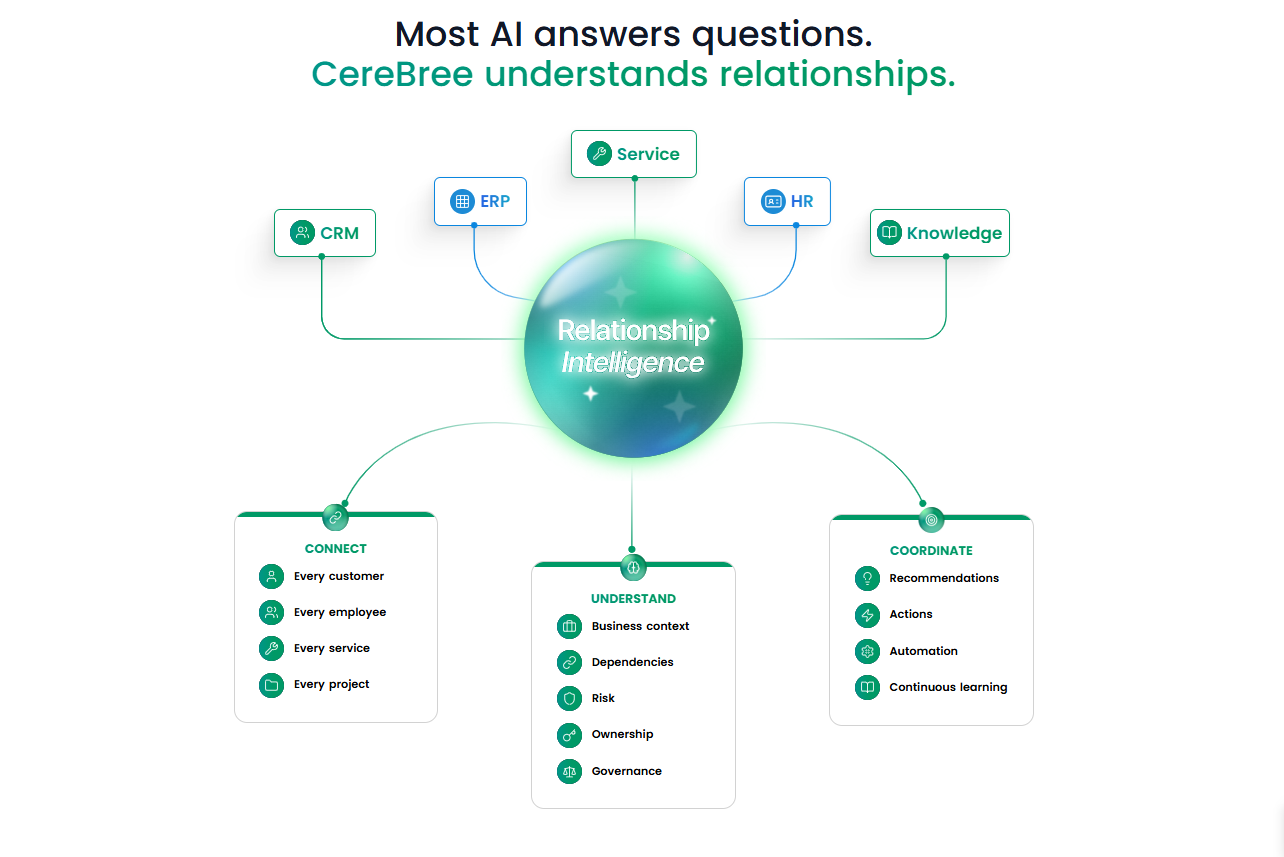
The enterprise side of CereBree focuses on connecting business systems and turning fragmented organizational information into coordinated decisions. CereBree describes its approach as an Enterprise AI Decision Layer, connecting customer, service, and workforce context. Instead of simply answering questions, the platform is designed to understand relationships, identify risks, coordinate recommendations, and support governed actions.
Its ecosystem includes solutions such as:
- HRX — enterprise relationship intelligence connecting customers, services, and workforce operations.
- uWork — AI career intelligence designed to help employees develop skills and navigate career opportunities.
- CereForge — part of the broader technology ecosystem.
This approach is built around the idea that organizations already have CRM, HR, ERP, service, and knowledge systems, but those systems often operate independently. CereBree aims to create a unified intelligence layer across them.
3. PeopleTech AI
The PeopleTech pillar focuses on human growth and personal development. CereBree envisions AI supporting people across different stages of life, including children, students, professionals, and lifelong learners. The platform can connect learning, skills, career development, mentorship, and personal growth rather than treating them as separate experiences. This is where CereBree's broader lifecycle intelligence concept becomes particularly important. Learning can influence career opportunities, career development can affect well-being, and health can influence a person's ability to learn and work. The objective is to make these relationships part of one intelligent ecosystem.
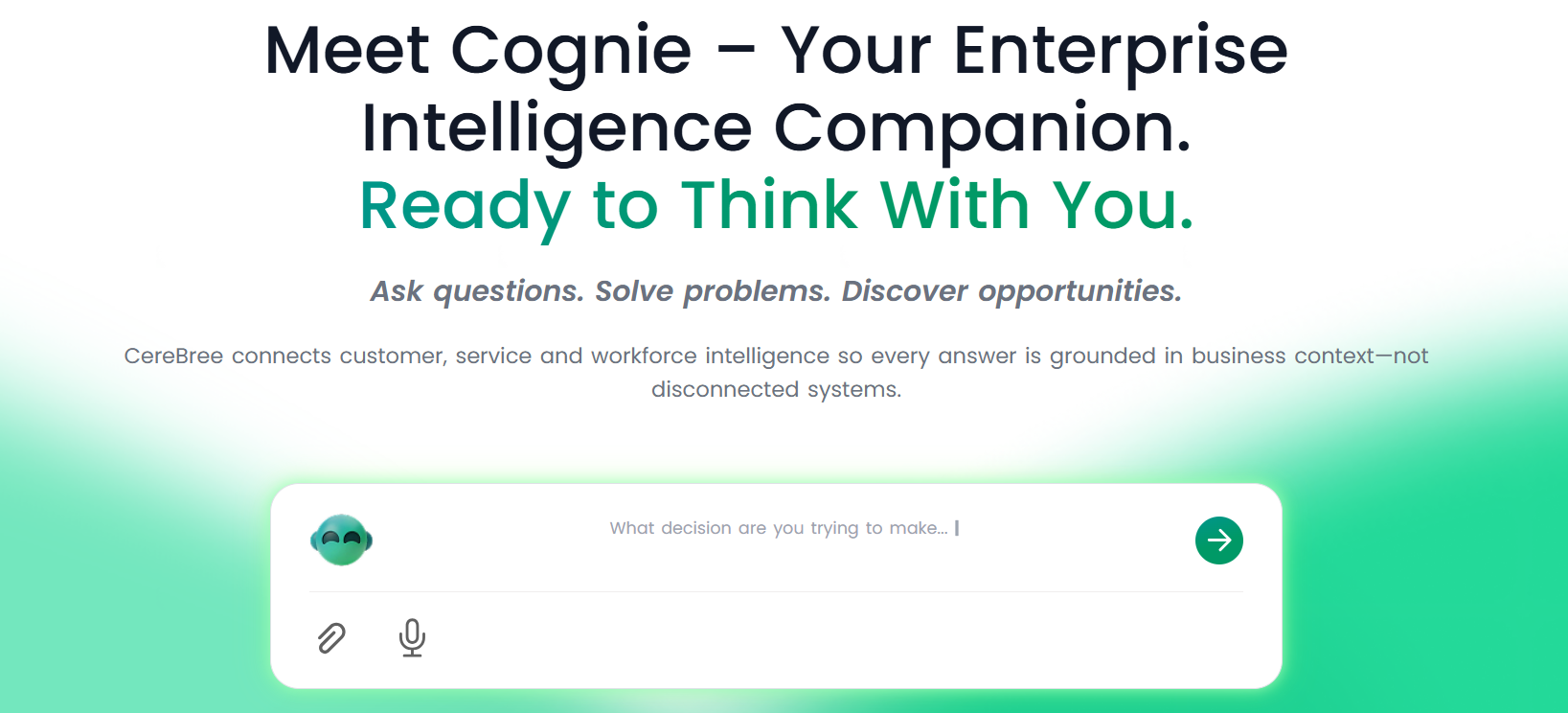
Cognie: CereBree’s AI Intelligence Companion
At the heart of the CereBree ecosystem is Cognie, an enterprise intelligence companion powered by CereBree’s proprietary LLM and AI technology. Rather than functioning as a conventional chatbot, Cognie is designed to serve as an intelligent interface that connects users with relevant business and human context. Through natural-language interactions, users can ask questions, explore solutions, identify opportunities, and receive contextual guidance. The goal is to make complex information easier to understand while helping users turn insights into meaningful actions.
What sets Cognie apart within CereBree’s broader vision is its role as more than a general-purpose conversational AI. It is positioned as an intelligence layer for the CereBree ecosystem, capable of operating across different domains and bringing contextual intelligence into a variety of user experiences. In this way, Cognie represents CereBree’s effort to move beyond simple question-and-answer AI toward a more adaptable intelligence companion—one designed to understand context, support decision-making, and help users navigate the opportunities and challenges within the digital business environment.
Why CereBree Could Matter in the AI Era
The AI revolution is rapidly evolving beyond simple chatbots, content generators, and isolated automation tools. As businesses and individuals integrate more AI into their daily workflows, a new challenge is becoming increasingly important: how can different AI systems work together while understanding the broader context needed to make useful decisions? This is where the vision behind CereBree becomes particularly relevant. CereBree presents itself as a lifecycle intelligence ecosystem for humans and enterprises, bringing together artificial intelligence, healthcare, enterprise operations, learning, career development, and personal growth within a connected framework. Instead of treating these areas as independent digital experiences, CereBree aims to connect them through shared intelligence.
The central idea is that life and business are already interconnected. A person's education can influence their career, their career can influence their well-being, and their health can affect their ability to learn and work. Similarly, within an organization, customers, employees, services, projects, and operational decisions are closely connected. CereBree's approach is designed to recognize these relationships rather than treating every workflow as an isolated problem.
The Way CereBree Connects Customer, Workforce, and Service Intelligence
Modern enterprises often have plenty of data but struggle to turn that data into coordinated decisions. Customer information may live inside a CRM, service activity inside an ITSM platform, and employee information inside HR systems. These systems can each be useful individually, but the lack of shared context can make it difficult to understand how one business relationship affects another. CereBree approaches this problem through an Enterprise AI Decision Layer designed to connect customer, service, and workforce context. Its goal is to move beyond isolated systems and create a unified view of the relationships that drive business operations.
1. Connecting Customer Intelligence
Customer intelligence is more than storing contact information or tracking sales opportunities. A complete customer picture can include interactions, deals, support requests, sentiment, engagement, and account health. CereBree's HRX framework brings these signals together through its CRM capabilities. The platform describes features such as a 360-degree customer view, AI sales forecasting, sentiment analysis, customer journey mapping, and account health scoring. This creates an opportunity to understand customers in context rather than viewing each interaction as an isolated event.
For example, a change in customer sentiment could become more meaningful when considered alongside service incidents, account activity, or internal ownership. Instead of simply asking "What happened with this customer?", an intelligent system can help organizations ask "Why is this relationship changing, and what should we do next?"
2. Connecting Workforce Intelligence
The workforce is another critical part of the enterprise relationship network. Employees influence customer outcomes, service quality, project delivery, and organizational performance. Yet workforce information is frequently separated from customer and service data. CereBree's HRX architecture includes CereWork, which focuses on the employee lifecycle from hiring and onboarding through development, performance, and growth. Its platform describes capabilities including employee lifecycle management, predictive onboarding, performance and OKR tracking, AI-assisted growth, and employee self-service.
By bringing workforce information into the same broader intelligence architecture, organizations can potentially understand relationships between people and operational outcomes. For instance, if particular teams become overloaded while service demands increase, workforce context can become important to understanding service performance. CereBree explicitly presents questions such as which teams are overloaded as examples of decisions its intelligence layer can help address.
3. Connecting Service Intelligence
Service operations generate another major stream of enterprise intelligence. Tickets, incidents, assets, changes, SLAs, and recurring problems can reveal important information about the health of an organization. CereBree's uSMS (Universal Service Management System) is designed to bring AI-powered automation and intelligence into these processes.
Its described capabilities include AI ticket classification, change and release control, configuration and asset management, SLA management, self-service AI, and problem-root-cause analysis. The important idea is that service information should not remain isolated inside an IT department.
$CRX Tokenomics: The Economic Engine Behind CereBree
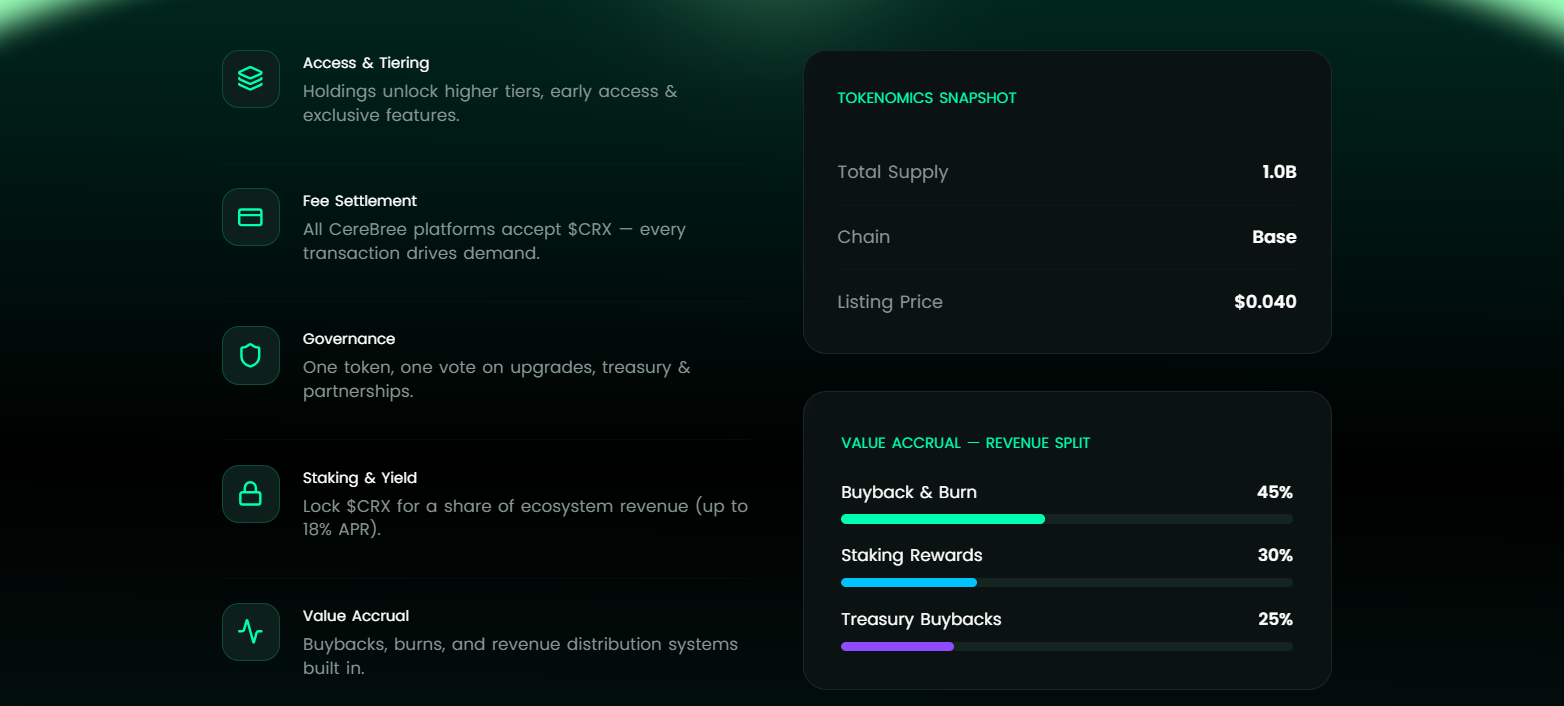
$CRX is the utility and governance token designed to connect participants across the CereBree ecosystem. Rather than being the product itself, $CRX functions as the economic layer supporting access, payments, incentives, staking, rewards, and decentralized governance. The core idea is straightforward: CereBree’s platforms create utility, while $CRX aligns the incentives of the people and organizations participating in that ecosystem.
Token Details:
- Token: $CRX
- Total Supply: 1 billion
- Blockchain: Base
- Listing Price: $0.040
- Buyback & Burn allocation: 45%
- Staking Rewards allocation: 30%
- Treasury Buybacks allocation: 25%
Five Core Utility of $CRX
1. Access and Tiering
$CRX holdings determine access levels throughout the ecosystem. Higher holdings can unlock early access, priority support, exclusive features, and other ecosystem benefits.
2. Fee Settlement
CereBree platforms accept $CRX for one-time purchases, subscriptions, and credits. This creates a direct connection between platform usage and token demand.
3. Governance
$CRX also provides governance rights. Token holders can participate in decisions concerning ecosystem upgrades, treasury allocation, feature priorities, partnerships, and other strategic developments through a one-token, one-vote model.
4. Staking and Yield
Users can lock their $CRX and receive a proportional share of ecosystem revenue. Three staking periods are described:
- 30 days: 8% APR
- 90 days: 12% APR
- 180 days: 18% APR
Longer lock periods are designed to provide higher rewards while encouraging longer-term participation.
5. Ecosystem Rewards
$CRX can also be distributed as an incentive for valuable contributions, including referrals, content creation, bug bounties, and early-adopter participation. This gives users additional reasons to contribute beyond simply holding the token.
How $CRX Value Accrual Works
According to the provided tokenomics, 100% of $CRX platform revenue is directed back into the ecosystem through three primary mechanisms.
45% — Buyback and Burn
The largest allocation is dedicated to buybacks and permanent token burns. CereBree uses this portion of revenue to purchase $CRX from the open market and remove those tokens from circulation. The intended mechanism is simple: as platform activity generates more revenue, more capital can potentially be directed toward token buybacks and burns, reducing the circulating supply.
30% — Staking Rewards
Thirty percent of the revenue allocation goes toward staking rewards. These rewards are distributed proportionally among eligible stakers across the available lock pools. The structure also encourages longer-term commitments by offering higher stated APRs for longer lock periods.
25% — Treasury Buybacks
The remaining 25% is allocated to treasury buybacks. These funds can support ecosystem development, AI model development, infrastructure, and operational requirements, with spending governed by token holders. This creates a feedback loop in which the treasury can potentially help finance further development and expansion of the ecosystem.
Conclusion
CereBree represents a broader vision of what AI ecosystems could become in an increasingly connected digital world. Instead of treating enterprise operations, healthcare, education, career development, and personal well-being as separate and unrelated categories, CereBree aims to connect them through a shared intelligence architecture. Its ecosystem brings together three major domains: DeepTech AI, HealthTech AI, and PeopleTech AI, creating a foundation for intelligence that can extend across different areas of life and work. At the center of this ecosystem is Cognie, CereBree's proprietary execution-focused LLM. Cognie is designed to serve as a shared intelligence layer across the ecosystem, helping different products and platforms operate with greater context and coordination.
CereBree is building toward a model in which AI can better understand these relationships instead of treating every interaction as an isolated event. This is the central promise of lifecycle intelligence: creating systems that can work with broader context, recognize connections between different stages of a journey, and potentially deliver more meaningful intelligence as that journey evolves.
Official Links of CereBree
- Website: https://cerebree.com/
- Whitepaper: https://cerebree.gitbook.io/docs
- X (Twitter): https://x.com/CereBree
- Telegram: https://t.me/CereBree
- Linkedin: https://www.linkedin.com/company/cerebreeofficial/
Author:
Bitcointalk username: BenitaElian
Bitcointalk link: https://bitcointalk.org/index.php?action=profile;u=3696741
Wallet Address: 0x6c1adAC9335eBb711891bbC4150fd0f53027970e