Evergain: Transforming Profitable AI Infrastructure Into a Sustainable and Transparent EVEG Growth Mechanism
The cryptocurrency industry is entering a phase where investors and users are increasingly looking beyond hype, short-term speculation, and purely narrative-driven tokens. As blockchain technology continues to mature, projects that connect digital assets with measurable real-world businesses are attracting greater attention. Evergain is positioning itself within this shift by combining cryptocurrency with two rapidly developing infrastructure markets: energy and artificial intelligence computing.
Evergain is built around the EVEG token, a BEP-20 cryptocurrency designed to connect the project's token economy with revenue generated from energy-powered AI/GPU compute infrastructure. Instead of building a collection of unrelated businesses, Evergain's current model focuses on a single core business: securing energy capacity, using that capacity to support GPU computing infrastructure, and providing computing resources to AI companies, startups, and enterprises. The project's central concept is straightforward: AI requires enormous amounts of computing power, GPUs require electricity, and reliable energy can therefore become a critical part of the AI infrastructure supply chain. Evergain intends to build around that connection and direct business revenue into a Treasury that can fund EVEG buybacks, infrastructure expansion, and liquidity.
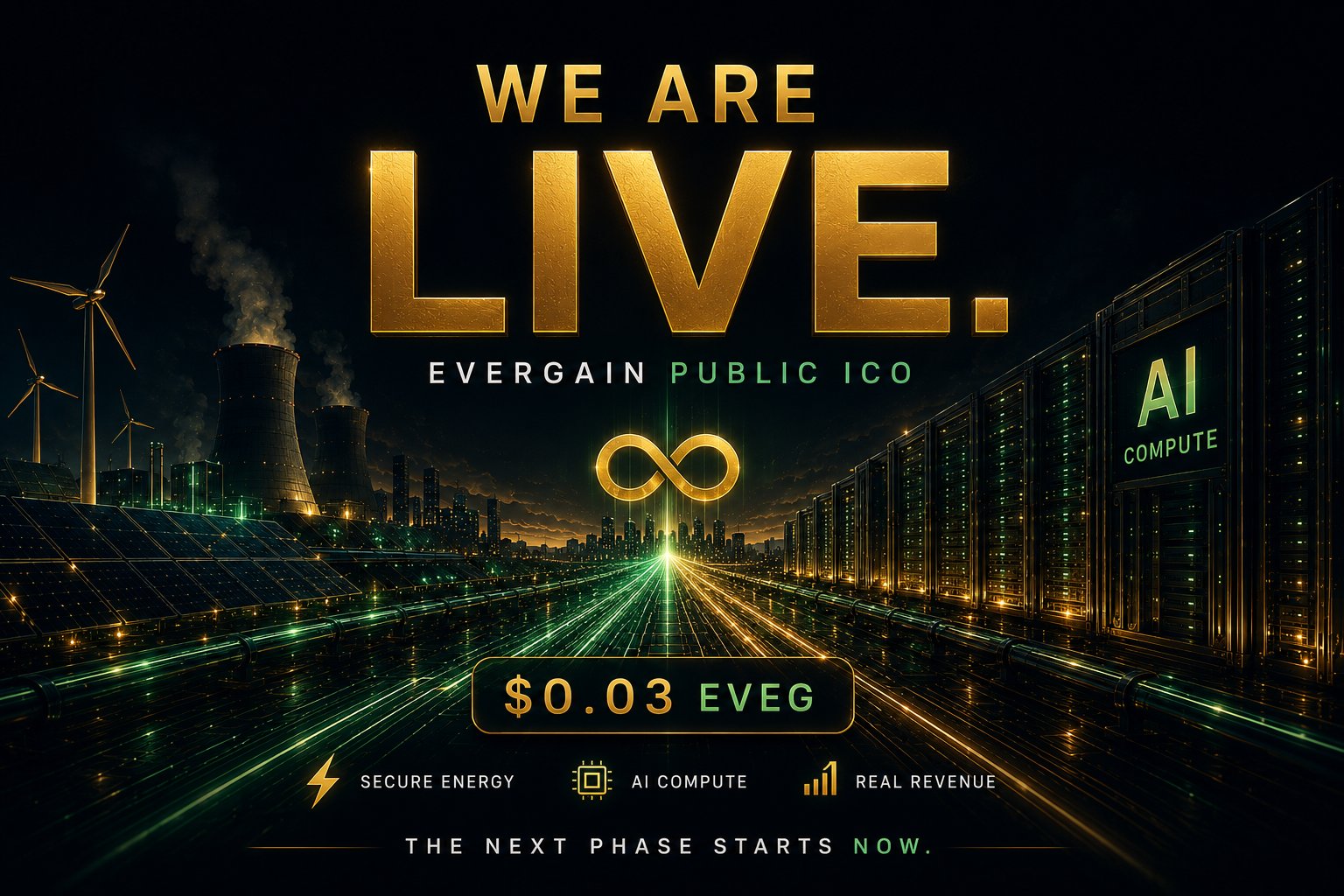
INTRODUCING Evergain
Evergain is a revenue-backed cryptocurrency project focused on energy-powered AI/GPU compute infrastructure. Its native token, EVEG, operates on the BNB Smart Chain as a BEP-20 token. Rather than relying solely on speculative market activity, Evergain is designed around an operating infrastructure model that aims to connect energy capacity, high-performance computing, and cryptocurrency utility within one ecosystem. At the center of Evergain's strategy is the acquisition of dedicated energy capacity through power purchase agreements (PPAs), with the potential for direct investments in energy infrastructure as the project develops. This energy capacity is intended to power GPU infrastructure that can be made available to organizations and businesses requiring substantial computing resources for applications such as AI training and inference. Revenue generated from the underlying compute business is planned to flow into the Evergain Treasury. According to the project's whitepaper, the Treasury is designed to serve three key functions: supporting EVEG token buybacks, funding the expansion of energy and GPU compute capacity, and helping maintain liquidity on exchanges. Through this approach, Evergain aims to establish a relationship between real-world infrastructure activity and the broader EVEG token ecosystem.
Evergain's model therefore brings together several growing sectors, including energy infrastructure, artificial intelligence, GPU computing, and blockchain. By focusing on the infrastructure required to support increasing demand for computational resources, the project aims to develop a long-term framework in which expanding compute capacity can contribute to business revenue and, in turn, support the wider EVEG ecosystem. However, it is important to distinguish the project's utility-token model from traditional equity ownership. The Evergain whitepaper explicitly states that EVEG is a utility token and does not represent equity or ownership in Evergain or any related entities. It also states that there is no guarantee of profit, returns, or future token price performance. As with any cryptocurrency or infrastructure-focused project, users and investors should independently evaluate the project's documentation, business model, risks, and development progress before making decisions.
The reason to Choose Evergain
Evergain presents an interesting approach by connecting blockchain utility with energy-powered AI and GPU computing infrastructure. The project focuses on securing energy capacity and using it to support high-demand computing resources for AI-related workloads. This infrastructure-driven strategy gives Evergain a clear focus on the growing demand for computational power.
Real-World Utility
Evergain is designed around real-world business activity rather than purely speculative use cases. The EVEG ecosystem is connected to revenue-generating operations, with its core business focused on energy-powered AI and GPU computing infrastructure. This gives the project a tangible utility layer tied to an expanding technology sector.
Transparent System
Transparency is an important part of the Evergain model. Blockchain technology enables transactions and relevant ecosystem activity to be publicly verifiable on-chain, giving participants greater visibility into the movement and use of digital assets. This approach helps create a more open and accountable environment.
Revenue-Driven Model
Evergain connects business performance with its token ecosystem through a revenue-driven model. According to the project's model, profits generated by its operations can support token buybacks, creating a mechanism intended to strengthen long-term token economics. Rather than depending exclusively on market speculation, the model seeks to connect value creation with underlying business activity.
Global Vision
Evergain maintains a focused vision built around energy-powered AI compute. Instead of spreading its resources across unrelated industries, the project concentrates on developing infrastructure for AI and GPU workloads. As demand for computational power continues to expand globally, Evergain aims to position its ecosystem around this evolving market while building a scalable foundation for future growth.
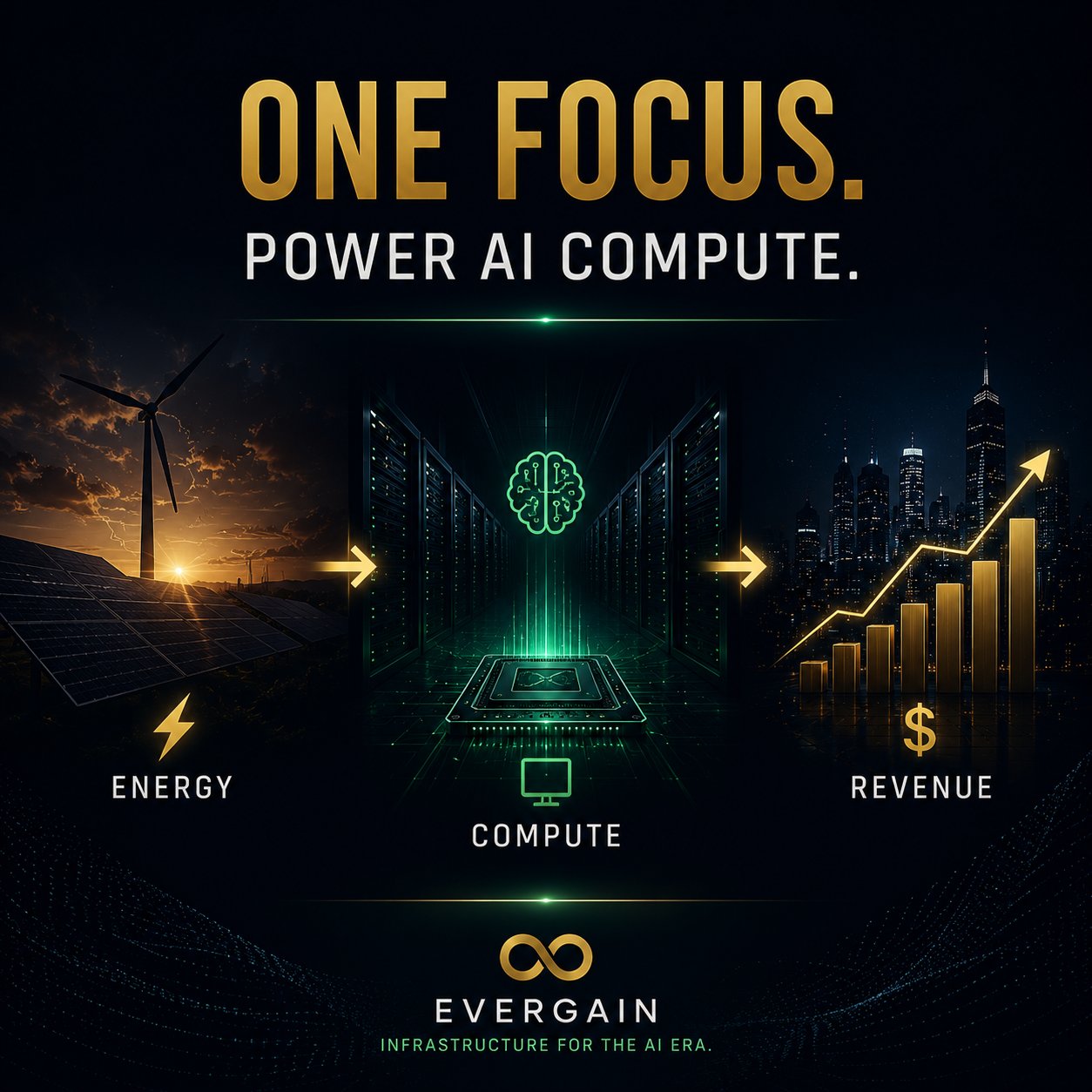
Why Evergain Is Focused on AI Compute and Energy
The rapid growth of artificial intelligence is driving significant demand for advanced computing infrastructure. Training and operating sophisticated AI models requires powerful GPUs capable of processing intensive workloads, while those GPUs depend on substantial and reliable electricity. Evergain's core thesis is that energy capacity and computing capacity are increasingly interconnected infrastructure requirements. This relationship is central to Evergain's proposed business model. Instead of functioning simply as another cloud-computing reseller, the project aims to establish a closer connection between energy procurement and GPU infrastructure. Its initial strategy involves securing energy capacity through power purchase agreements (PPAs) and using that capacity to support AI and GPU computing operations.
Energy is particularly important for compute-intensive infrastructure because electricity can represent a significant portion of operating expenses. Securing dependable and potentially cost-effective energy could therefore play an important role in the economics of an AI compute business. For Evergain, energy procurement is intended to be more than an operational requirement—it is positioned as a potential strategic component of its long-term approach to AI infrastructure.
The Evergain AI/GPU Compute Model
The second major element of Evergain's ecosystem is its planned AI/GPU compute infrastructure. According to Whitepaper v2.0, the project intends to deploy and lease GPU computing capacity to AI companies, startups, and enterprises that require resources for workloads such as AI model training and inference. The initial strategy involves cloud-leased GPU clusters, while the longer-term vision includes potentially transitioning toward owned hardware as business revenue allows. This approach places Evergain within a real-world market for computing services. Organizations developing AI applications may not always want to purchase, operate, and maintain their own high-performance GPU infrastructure. Instead, they can use external computing providers through subscription models, usage-based services, or dedicated capacity. Evergain's proposed model aims to serve this demand by providing GPU resources while simultaneously focusing on the energy requirements behind those operations.
The planned business model is expected to generate subscription- and usage-based revenue, which could then contribute to the Evergain Treasury. This creates the intended connection between infrastructure activity and the project's broader token ecosystem: energy supports computing capacity, computing capacity generates potential business revenue, and Treasury resources can be directed toward areas such as expansion and EVEG buybacks. Nevertheless, successful execution will be critical. The model depends on factors such as infrastructure deployment, access to suitable energy capacity, operating efficiency, and customer adoption. Evergain's whitepaper also identifies client adoption and successful deployment as potential risks. Therefore, the AI/GPU compute model should be understood as the project's planned development strategy, rather than a guarantee of future revenue or business performance.

How the Evergain Revenue Model Works
One of the most important aspects of Evergain is its proposed relationship between real-world business revenue and EVEG. The model can be understood in several stages.
1. Secure Energy Capacity
Evergain plans to establish energy partnerships through PPAs and potentially direct investments in energy capacity over time.
2. Deploy AI/GPU Infrastructure
The secured energy capacity is intended to support GPU infrastructure capable of serving AI-related workloads.
3. Sell Computing Capacity
AI companies, startups, and enterprises can potentially use the infrastructure for training, inference, and other computing requirements.
4. Generate Business Revenue
Revenue from providing computing capacity enters the Evergain ecosystem.
5. Allocate Treasury Resources
According to the whitepaper, Treasury resources are intended for EVEG buybacks, infrastructure expansion, and exchange liquidity.
6. Expand the Business
Additional energy partnerships and GPU capacity can potentially increase the project's operational capacity over time.
This creates the project's proposed closed-loop model. The official website describes the same concept as a continuous cycle in which business profits contribute to EVEG repurchases and the expansion of the ecosystem.
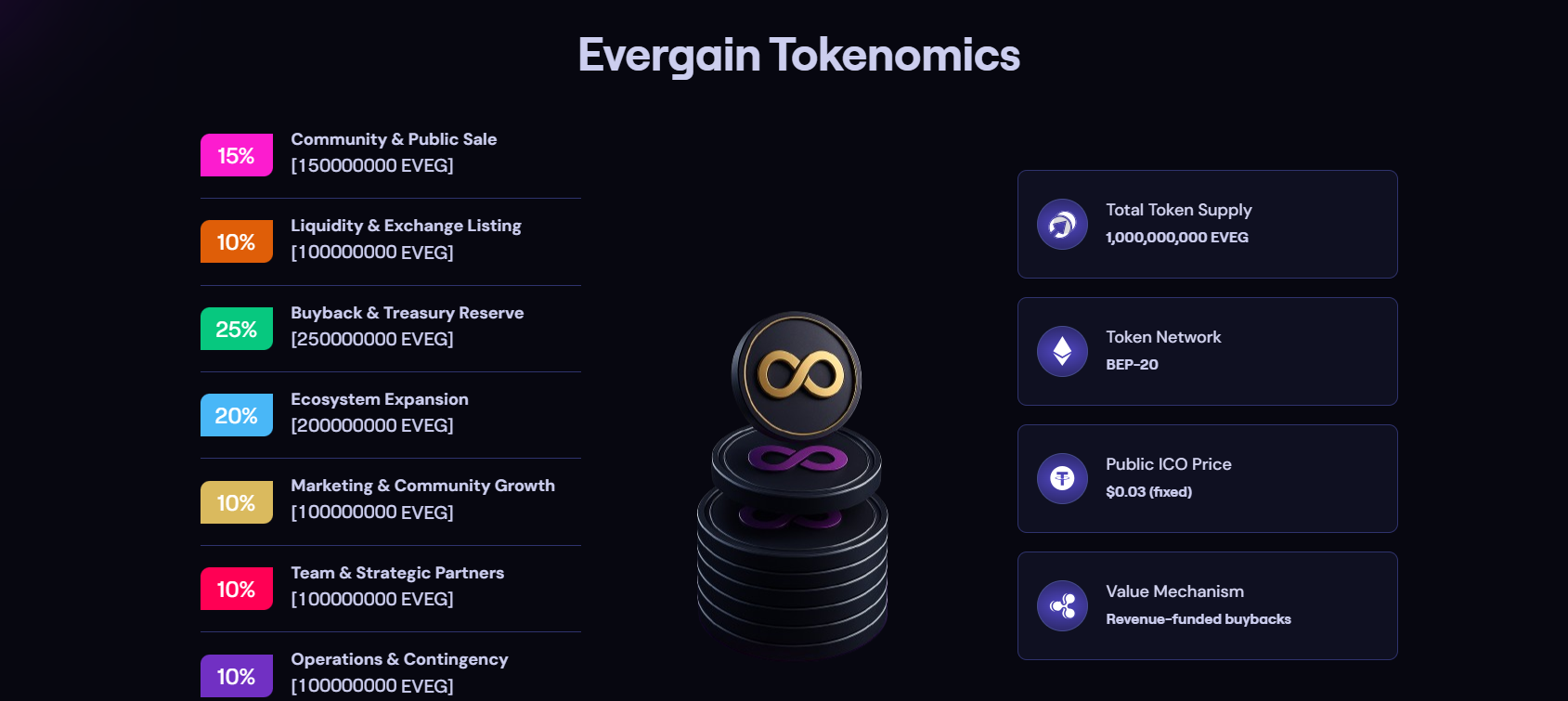
Evergain Tokenomics
- Total Token Supply: 1,000,000,000 EVEG
- Token Network: BEP-20
- Public ICO Price: $0.03 (fixed)
- Value Mechanism: Revenue-funded buybacks
EVEG Token Distribution Model
- Community & Public Sale: 15%
- Liquidity & Exchange Listing: 10%
- Buyback & Treasury Reserve: 25%
- Ecosystem Expansion: 20%
- Marketing & Community Growth: 10%
- Team & Strategic Partners: 10%
- Operations & Contingency: 10%
EVEG Token Public ICO Details
- Structure: single-stage Public Sale (no presale bonus tiers)
- Dates: July 21 to November 21, 2026
- Price: $0.03 per EVEG, fixed for the duration of the sale
- Soft Cap: $600,000
- Hard Cap: $2,500,000
- Minimum contribution: 500 EVEG (≈ $15)
- Maximum contribution: 2,500,000 EVEG per person (≈ $75,000)
- Referral program: inviter and invited participant each receive a 10% EVEG bonus on a
completed purchase - Unsold tokens: any portion of the ICO allocation not sold by the close of the sale is
permanently burned
ICO link: https://evergaincoin.com/dashboard/register
Roadmap
Phase 1: Relaunch Foundation (Q3 2026)
- Complete independent smart contract audit ahead of the Public ICO
- Publish updated whitepaper, website, and dashboard
- Run the single-stage Public ICO (July 21 to November 21, 2026)
- Begin structuring the first energy PPA
- Launch the public multisig Treasury wallet and reporting dashboard
Phase 2: Infrastructure Deployment (Q4 2026)
- DEX listing and initial liquidity provisioning
- Deploy first leased GPU cluster and onboard initial compute clients
- Finalize first energy PPA agreement
- Begin first Treasury buyback operations
- Publish first quarterly transparency report
Phase 3: Scale (Q1 to Q2 2027)
- Expand GPU capacity in line with client demand
- Pursue first centralized exchange (CEX) listing
- Expand energy partnerships and evaluate direct energy investment
- Formalize a recurring buyback cadence
Phase 4: Maturity (H2 2027)
- Expand enterprise client base for AI compute services
- Evaluate owned GPU hardware investment versus continued leasing
- Introduce community input on Treasury parameters
- Continue transparent reporting and reinvestment
Conclusion: Evergain's Vision for AI, Energy and Crypto
Evergain is positioning EVEG as a cryptocurrency designed to connect with the real-world infrastructure supporting the growing AI economy. By bringing together blockchain technology, energy capacity, and artificial intelligence computing, the project presents a business-focused approach to the evolving relationship between digital assets and physical infrastructure. Rather than depending entirely on market speculation, Evergain's model is built around the concept that AI and GPU computing infrastructure can generate business revenue, which can then support a transparent Treasury. According to the project's proposed model, the Treasury can help fund EVEG buybacks, infrastructure development, and liquidity, creating a potential cycle between real-world business activity and the token ecosystem. However, Evergain remains a developing project, and its long-term success will depend on execution. Key factors include customer adoption, successful infrastructure deployment, energy partnerships, regulatory compliance, operational performance, and broader market conditions. As with any cryptocurrency project, investors and users should conduct their own research and evaluate both the potential opportunities and associated risks. For anyone researching Evergain, EVEG, AI crypto projects, revenue-backed cryptocurrencies, GPU compute infrastructure, or energy-powered blockchain initiatives, the most important factor to monitor is the project's ability to build and operate the real-world business supporting its token model. Token performance alone does not demonstrate the success of the underlying infrastructure.
For more information
- Website: https://evergaincoin.com/
- Telegram Channel: https://t.me/Evergainchannel
- X (Twitter): https://x.com/Evergaincoin
- Discord: https://discord.gg/KrNawdt3HB
- Whitepaper: https://evergaincoin.com/whitepaper.pdf
Author:
Bitcointalk username: BenitaElian
Bitcointalk link: https://bitcointalk.org/index.php?action=profile;u=3696741
Wallet Address: 0x6c1adAC9335eBb711891bbC4150fd0f53027970e