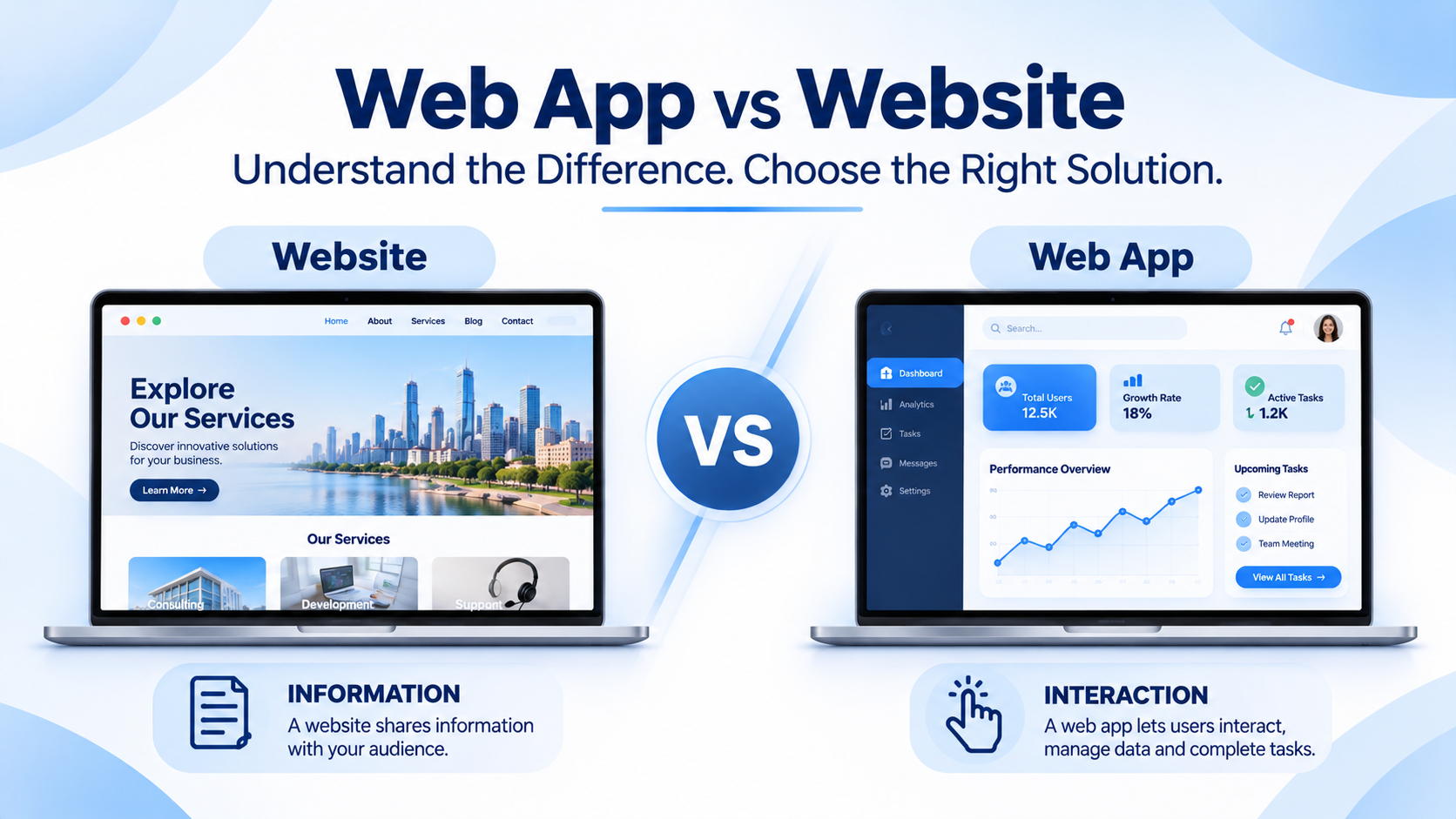
How does web app development differ from website development?
- A website is built to publish content, and a web app is built to run a process.
- Web apps need a backend, a database and user accounts, while most websites need a content system and templates.
- A web app team is bigger, with analysts, backend and frontend developers, and testers.
- Security and testing are far stricter for web apps because they store personal and business data.
- A website can launch in weeks, but a web app usually takes months and needs ongoing releases.
Two projects can look alike on a phone screen and still be built in completely different ways. Web app development involves planning, architecture and testing that a normal website never needs. If you are about to brief a developer, knowing where the two diverge will save you from a wrong quote and a wrong build.
This article compares them stage by stage, with Australian costs and timelines.
Start with the goal: pages versus workflows
A website is a set of pages. The main job is to present information and get the visitor to call, buy or enquire. Everyone sees roughly the same thing.
A web app is a workflow. Users log in, complete tasks and see data that belongs to them, like a booking calendar or an order history. The first planning question is therefore different: for a website you ask what people need to read, and for a web app you ask what people need to do.
How web app development differs in tech and architecture
Most websites sit on a content system like WordPress or Webflow, with a theme, a few plugins and a hosting plan. A developer customises templates, and staff edit content themselves.
A web app is closer to custom software. A typical build has a frontend framework such as React or Vue, a backend in Node.js, Python or .NET, a database like PostgreSQL, and APIs that connect it to other tools. Each layer is designed, built and tested separately.
That extra structure is what lets an app remember users, apply business rules and handle thousands of actions a day. It is also why you cannot turn a basic website into a web app with a plugin.
The team behind each build
A small business website is often built by a designer, one developer and someone who writes the copy. Three people can finish it in a month.
A web app usually needs more roles:
- A business analyst or product owner to define the scope.
- A UX designer to map user journeys, not just screens.
- Frontend and backend developers.
- A tester who writes and runs test cases.
- A DevOps engineer to manage hosting, deployment and monitoring.
On smaller projects one person covers two roles, but the work still exists. When a quote for a web app lists only “design and development”, ask where the rest is.
Testing and security: where web app development gets stricter
On a website you check that links work, forms send and pages load quickly. A bug is annoying, but it rarely harms anyone.
A web app holds customer records, invoices and sometimes payment details, so testing goes deeper. Teams test login rules, permission levels, data validation and what happens when two users edit the same record. Security reviews often follow the OWASP Top 10, a public list of common web vulnerabilities, and many projects add penetration testing before launch.
Australian businesses also have legal duties. The Privacy Act 1988 and the Notifiable Data Breaches scheme apply when you store personal information, so ask where your data is hosted and who can access it.
Timelines and costs side by side
The gap is large enough to affect your whole budget.
- Website: 2 to 6 weeks, often $3,000 to $15,000 in Australia.
- Web app: 3 to 9 months for a first version, often $30,000 to $150,000.
- Website upkeep: hosting, backups and occasional updates.
- Web app upkeep: regular releases, security patches and support, commonly 15 to 20 percent of the build cost a year.
These ranges move with scope, so treat them as a starting point. Our comparison of web app development and websites for business explains how to judge which side of the line your project sits on.
When a mobile app development company enters the picture
Web apps run in a phone browser, and for many businesses that is enough. Native apps become worth it when you need push notifications, background location, camera tools or offline use.
If that is likely, it helps to work with a mobile app development company that can reuse your web app’s backend and build iOS and Android versions with cross-platform tools. You pay for the shared logic once instead of twice.
How to decide what to build
Use this short check before you request quotes.
- Write the one task your users must complete.
- If the task is reading or contacting you, build a website.
- If it needs logins and saved data, plan a web app.
- If it needs device features, add a mobile app after the web app proves itself.
- Start with the smallest version that solves the task.
Many projects mix the two. A company site with a customer portal behind a login is a good example, and it is often the cheapest way to start. Build the website first, add one app feature, and let real use show you what to build next.
Frequently asked questions
Is web app development harder than website development?
Yes, in most cases. It involves a backend, a database, user accounts and deeper testing, which adds planning and build time.
How long does web app development take compared with a website?
A website often takes 2 to 6 weeks. A first web app version usually takes 3 to 9 months, depending on features and integrations.
Can I build a web app on WordPress?
Only simple ones, like a membership area or booking form. Anything with complex rules, many user roles or heavy data work needs custom development.
Do web apps need more maintenance than websites?
Yes. Web apps need security patches, dependency updates, monitoring and new releases, while a website mainly needs backups and content changes.
Can a website grow into a web app?
It can grow in stages. Add a login area or a single tool first, then move to a full web app when the process proves its value.