Are We Our Protagonists?
When I write short fiction, I usually name my protagonists K, Mr. or Mrs. K, as a sort of homage to Franz Kafka and his way of naming main characters, at least in the works of his that I've read.
Some people ask, or jokingly claim, what K is or seems to be. I can't say that K is an autobiographical character, and I can't say that K isn't one.
As people living in a world, we keep acquiring experiences and interpretations of them, almost always based on previous experiences, in an unconsciously circular way.
At least that is what I believe: that we cannot split ourselves off from our characters, because they are a product of our perception of the world. Maybe I'm completely wrong, it's possible, but, given my beliefs, I probably consider it more likely that I'm right.
Some will want to analyze us based on what we write, as I am doing with the book I'm reading right now: No Longer Human (Indigno de ser humano). Although I'm only about 40 or 50 pages in, I can't stop thinking it is an autobiographical work and a kind of literary manifesto.
But that is my interpretation after learning about the author's life and death. We will never know whether Yozo was the voice with which Dazai told his own story, disguising it as fiction. Or whether he was someone from his circle, or a critique of the society of his time.
I must admit that I "talked" about this with Claude (I know it's a bit pathetic) and that we exchanged ideas, and from them I was able to take away that I'm not the only person who thought something like this. After all, why would I be, if I am a product of my society, my era, and my circumstances?
But at the end of the day it doesn't matter whether characters are our alter egos, or ourselves, or "fictional" creations based on past events and even on literary works we've already read that stayed in our subconscious, because, really, the interpretation will be personal, in a way, for each of us.
Sometimes what truly matters about a story is what we hope to achieve by writing it, and not the why or the what for. There are works that never saw the light of day because maybe they were a therapeutic exercise for the author, or because they simply failed to pass the censorship of the inner judge, or because the whims of fate keep them in oblivion, in "the trash heap," which is what they called the unpublished manuscripts (almost always unread) sent to literary agents in search of a chance, in the film My Salinger Year (2020).
For a long time, literature was for me a recreational experience, out of the simple satisfaction of enjoyment and disconnection from the real world, with no great pretension of understanding or deciphering what the author meant, or whether the characters and events are real or fictionalized. Maybe it's a simplistic and mediocre way of approaching the experience as a reader, but if I wanted to know what hides behind a story or why it was written, I would have been better off becoming a psychologist or psychiatrist, and even so my reading would be a personal interpretation of the facts.
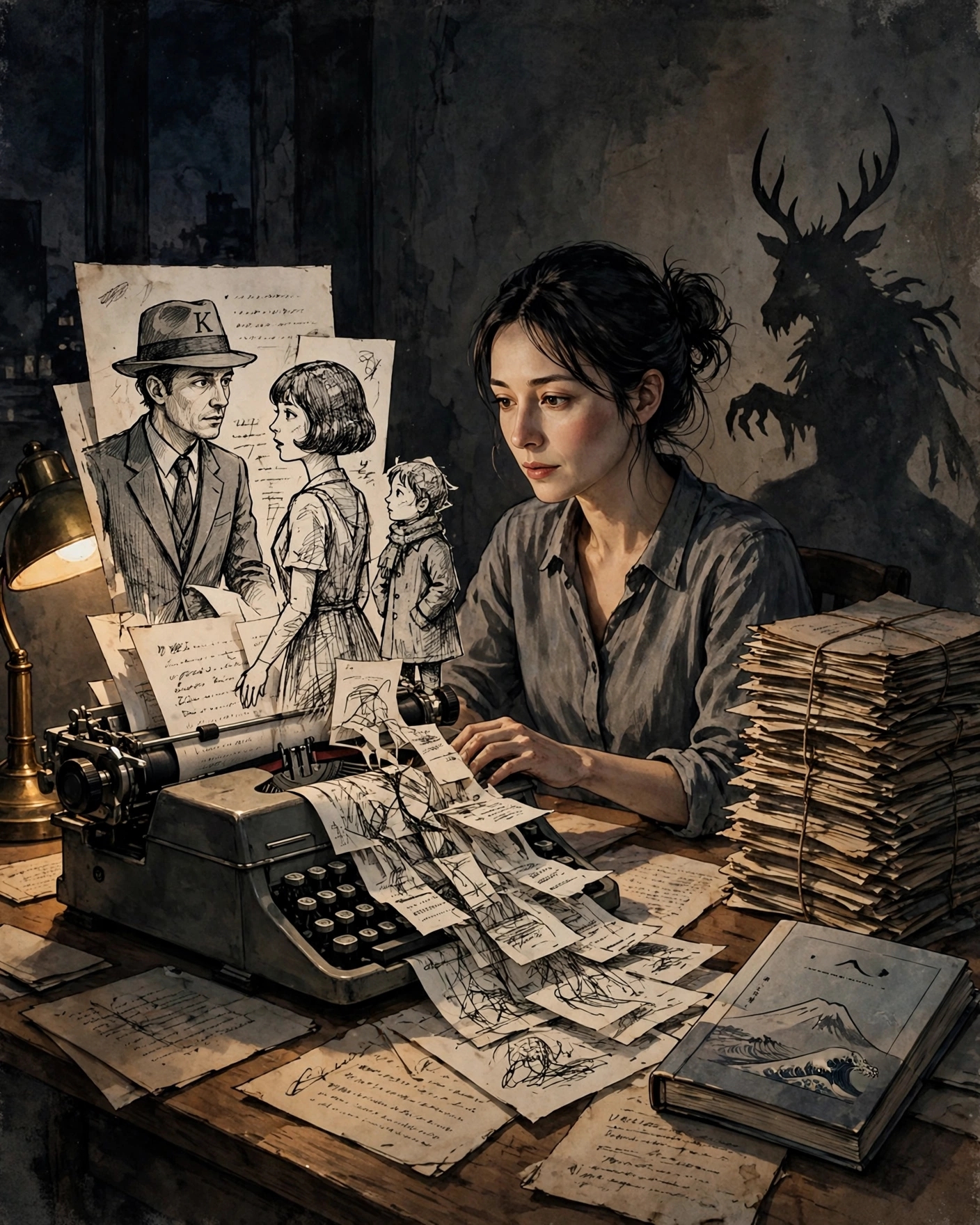
Los protagonistas, ¿somos nosotros mismos?
Escribiendo algunos textos de ficción corta suelo nombrar a mis protagonistas casi siempre como K, señor o señora K, en una especie de homenaje a Franz Kafka y su estilo de nombrar a los personajes principales, al menos en las obras que he leído de él.
Algunas personas suelen preguntar, o afirmar en forma divertida, lo que K es o parece ser. No puedo decir que K sea un personaje autobiográfico y tampoco puedo decir que no lo sea.
Como personas que viven en un mundo, vamos adquiriendo experiencias e interpretaciones de las mismas, casi siempre basadas en experiencias previas, de una forma inconscientemente circular.
Al menos eso es lo que creo yo, que no podemos desdoblarnos de nuestros personajes porque son un producto de nuestra percepción del mundo. Tal vez me equivoque diametralmente, es posible, pero, debido a mis creencias, probablemente considero más probable tener razón.
Algunos querrán analizarnos a partir de lo que escribimos, como estoy haciendo yo con el libro que estoy leyendo ahora mismo: "Indigno de ser humano". Aunque voy por las primeras 40 o 50 páginas, no puedo dejar de pensar que es una obra autobiográfica y una especie de manifiesto literario.
Pero esa es mi interpretación luego de conocer la vida y muerte del autor. Nunca sabremos si Yozo fue la voz con la que Dazai escribió su propia historia disfrazándola de ficción. O si fue otra persona de su entorno, o si fue una crítica a la sociedad de su época.
Debo reconocer que "hablé" del tema con Claude (sé que es un poco patético) y que intercambiamos ideas, y de ellas pude rescatar que no soy la única persona que pensó algo así. Después de todo, ¿por qué lo sería, si soy un producto de mi sociedad, de mi época y de mis circunstancias?
Pero al final del día da lo mismo si los personajes son nuestros alter egos o nosotros mismos, o creaciones "ficticias" basadas en hechos del pasado e incluso en obras literarias que ya hemos leído y quedaron en nuestro subconsciente, porque realmente la interpretación será personal, en cierto modo, para cada uno.
A veces lo que verdaderamente importa de una historia es lo que deseamos conseguir al escribirla, y no el porqué ni el para qué. Hay obras que nunca vieron la luz pública porque tal vez fueron un ejercicio terapéutico del autor, o porque sencillamente no lograron pasar la censura propia del juez interno, o porque el azar del destino las mantiene en el olvido, en "el montón de basura", que es como llamaban, en la película Mi año con Salinger (My Salinger Year, 2020), a los manuscritos no publicados (casi siempre no leídos) enviados a agentes literarios en busca de una oportunidad.
La literatura fue por mucho tiempo para mí una experiencia recreativa, por la simple satisfacción de disfrute y desconexión del mundo real, sin mayores pretensiones de entender o descifrar qué quiso decir el autor, o si los personajes y hechos son reales o ficcionados. Tal vez sea una forma simplista y mediocre de afrontar la experiencia como lectora, pero si quisiera saber lo que se esconde tras una historia o por qué fue escrita, mejor me hubiera hecho psicóloga o psiquiatra, y aun así mi lectura sería una interpretación personal de los hechos.
Original language / Idioma original: Spanish / Español
Spelling editing and translation / Edición ortográfica y traducción: Claude (Anthropic)
Image generation / Generación de imagen: Meta AI
The literary ‘I’... My protagonists are usually either the way I’d like to be, or the way I definitely don’t want to be. I myself probably fall somewhere in between. Writing helps me to reflect and question myself in that way. Sometimes it even helps me to have a bit of a laugh at myself ;-))
0.00 SBD,
0.97 STEEM,
0.97 SP
It's a good literary path; my characters are almost always male. It's nothing personal, in case you were wondering! 😂
0.00 SBD,
0.15 STEEM,
0.15 SP
I have not read Kafka yet but I really like the idea of naming the characters like that. I think it keeps the focus on the story itself, not the name or who the character may relate to. Some names have associations that may affect the outcome of the story.
You are right. Some characters in stories are based on people the author knew, or part of themselves or in people they observed.
0.00 SBD,
0.94 STEEM,
0.94 SP
He has some very good works; I would tell you to start with "Notes from Underground," but of course his most famous work is "The Metamorphosis."
I agree with you, characters are a sum of many things!
0.00 SBD,
0.04 STEEM,
0.04 SP
There's a podcast "Hardcore Literature" that discussed his work.
I'll look for it! The channel sounds very interesting, thanks!
0.00 SBD,
0.04 STEEM,
0.04 SP
I've never heard of "Notes from Underground" by Kafka - maybe, the German title runs another way.
Or did you mean one of Dostojewsky's works which Kafka had read?
The most famous works in German speaking countries are "Der Prozess" and "Das Schloss".
"Der Prozess" / "The Trial" (1914/15) gives us the story of Josef K., who is arrested completely out of the blue and finds himself caught up in an opaque, absurdly bureaucratic legal process.
"Das Schloss" / "The Castle" (1922) tells about the surveyor K. who struggles in vain to be recognised by the mysterious castle and its officials as being entitled to work there and as one of their own.
Both novels are nightmares and are told in the way of someone who cannot awake.
"Die Verwandlung" / "The Metamorphosis" (1915) runs similar in this respect and relates in some way on Dostojewky's "Notes" from 1864.
You're right! I was confusing the author! It's Dostoevsky... I must start to doubt my memory. 😆
I've been meaning to read The Castle for over 10 years, but the protagonist's constant frustration keeps getting in the way. I should finally finish it this year (I've started it dozens of times).
You read it perfectly if the protagonist's constant frustration becomes yours!
A small correction @emmabritt, I had told you "Notes from Underground" as a work by Kafka, but luckily @ty-ty has a better memory than me and corrected me. It's actually by Dostoevsky, but it's very good!
...and nevertheless it is a good introduction before reading Kafka, it seems (since Kafka appreciated 'Notes from Underground' and referred to it).
I agree with Kafka; it's a work I must reread. I remember finding it very funny at that time, but I'm sure it wasn't written to be humorous.
I see. I'm reading your thread now. There are some interesting titles mentioned by ty that piqued my interest
You know the Z Library app... I'll send it to you via DM so you can look for those free books.
0.00 SBD,
0.06 STEEM,
0.06 SP
Sure, thank you! I'm currently using Gutenberg Project
Yes, that's a great option too!
Upvoted! Thank you for supporting witness @jswit.
Thanks a lot for your support @rokonn Have a great day 😊
Mirá, esa idea de que no podemos separarnos de nuestros personajes me quedó dando vueltas, y lo de "the trash heap" con los manuscritos sin leer es un dato que duele. Pero pensá una cosa: si K es un homenaje a Kafka, ¿no será que el nombre vacío ya es una forma de esconderse y mostrarse a la vez? Sentí que ahí está la cosa, en ese juego.
Lo de leer No Longer Human y no poder dejar de ver a Dazai en Yozo me pasó igual, tipo a las 40 páginas ya estás psicoanalizando al autor más que al personaje. La pregunta sería si te pasa lo mismo con tu propio K, pq ahí es donde se pone interesante el asunto.
Qué curioso que menciones a Dazai y ese “basurero” de manuscritos: lo que hoy leemos como obra maestra pasó por el mismo filtro del juez interno. Traducido a guaraníes, quizás la pregunta no es si K sos vos, sino cuánto de nosotros se filtra en lo que decidimos publicar.
Qué curioso, queridos hermanos, que mencione a Kafka y a Dazai en un mismo texto: ese K sin nombre completo es casi un reflejo de cuánto nos cuesta nombrarnos delante de nosotros mismos. En mi experiencia, cuando escribimos sobre un personaje siempre dejamos algo del alma en él, y elSeñor conoce esa intimidad mejor que nosotros. ¿Leyó ya algo más de Indigno de ser humano o sigue en esas primeras cincuenta páginas?
¿Y ese detalle de los manuscritos en "la pila de basura"? Increíble lo que se pierde ahí. Me quedé pensando en tu K y en ese 40 o 50 de No Longer Human, ¿lo terminaste?
Ha! I knew it, didn't I?
It must have been in the underground! 😉